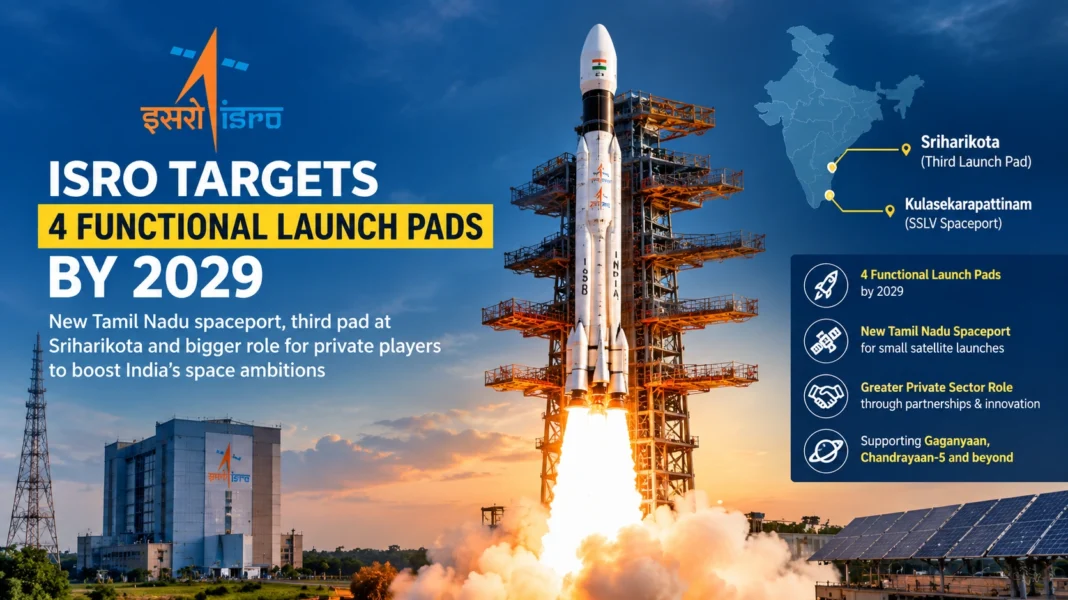
India plans to significantly expand its space-launch infrastructure, with four functional launch pads expected by 2029, Indian Space Research Organisation (ISRO) Chairman V. Narayanan has announced. The expansion is aimed at strengthening India’s launch capabilities, meeting rising domestic and international demand for satellite deployment and supporting the country’s growing commercial space sector.
The proposed infrastructure includes a third launch pad at Sriharikota in Andhra Pradesh and a dedicated Small Satellite Launch Vehicle (SSLV) launch complex at Kulasekarapattinam in Tamil Nadu. The announcement signals India’s ambition to increase launch capacity while preparing for more advanced space missions.
ISRO to Expand Launch Infrastructure by 2029
At present, India’s primary launch operations are conducted from the Satish Dhawan Space Centre at Sriharikota, which has two operational launch pads. The government approved the establishment of a third launch pad in January 2025 to support next-generation launch vehicles, human spaceflight missions and future lunar exploration.
The third launch pad is targeted for completion around 2029–30, according to the Department of Space. It is expected to provide additional capacity for more demanding missions and improve operational flexibility.
Meanwhile, the second launch site at Kulasekarapattinam is being developed specifically to support SSLV missions. Together, these facilities are expected to expand India’s launch infrastructure and help the country accommodate a wider range of satellite missions.
Tamil Nadu Spaceport to Support Small Satellite Launches
A key part of the expansion is the proposed 2,000-acre SSLV complex at Kulasekarapattinam in Tamil Nadu’s Thoothukudi district.
The facility is being developed to meet the growing demand for small satellite launches, particularly missions involving Earth-observation satellites. Its infrastructure is expected to include launch pads, integration buildings, rail-track systems and telemetry, tracking and command facilities.
The location is intended to offer operational advantages for launching satellites into sun-synchronous polar orbits, a type of orbit widely used for Earth observation and environmental monitoring.
The Department of Space has targeted the complex’s commissioning during the 2026–27 financial year, while SSLV launches from the new site are expected in 2027–28. These are planned timelines and remain subject to project progress.
Private Companies to Play a Bigger Role
Narayanan has emphasised that ISRO will not be privatised, while stressing the importance of partnerships with private companies and startups.
The agency intends to support emerging businesses through technology transfer, technical guidance and collaboration. Greater private-sector participation is expected to help expand launch services, encourage innovation and create skilled employment opportunities.
India opened its space sector to greater private participation in 2020, with the establishment of the Indian National Space Promotion and Authorisation Centre (IN-SPACe) helping facilitate and regulate non-governmental space activities.
The strategy is to expand the country’s overall space ecosystem while retaining ISRO’s central role in advanced research, strategic missions and space exploration.
Gaganyaan and Chandrayaan-5 Also on the Roadmap
The infrastructure announcement comes alongside developments in India‘s human spaceflight and lunar exploration programmes.
Narayanan said ISRO plans to conduct its first uncrewed Gaganyaan test within the next two months, followed by two additional uncrewed tests before attempting a crewed mission. These tests are intended to assess critical systems, including environmental controls, crew escape mechanisms and the spacecraft’s performance under different conditions.
He also outlined plans for Chandrayaan-5, a collaborative lunar mission with Japan’s space agency. The proposed mission is expected to feature a 350-kilogram rover designed to conduct scientific experiments on the lunar surface for approximately 100 days.
What the Expansion Means for India
Increasing launch capacity could help India respond to rising satellite demand, strengthen its position in the international commercial launch market and support more ambitious scientific missions.
However, achieving these goals will depend on the timely completion of infrastructure projects, technological readiness and effective coordination between ISRO and private industry.
If the planned facilities become operational within their target timelines, India could enter the next decade with greater launch flexibility and a stronger foundation for its expanding space ambitions.