
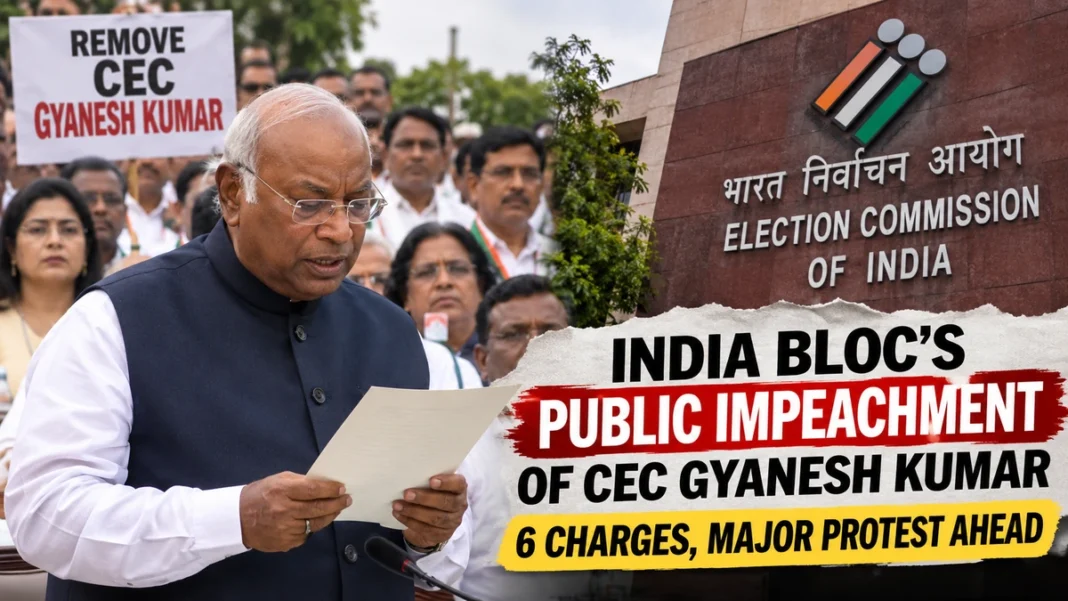
New Delhi, October 31, 2026: The Congress-led INDIA bloc on Saturday held a symbolic ‘public impeachment’ proceeding against Chief Election Commissioner (CEC) Gyanesh Kumar, accusing him of serious irregularities in the management of electoral rolls and the alleged manipulation of India’s electoral process.
The proceeding took place at the official residence of Congress president Mallikarjun Kharge in New Delhi. Former Lok Sabha Speaker Meira Kumar presided over the mock parliamentary proceedings, which were attended by several opposition leaders, Members of Parliament and representatives of civil society organisations.
During the event, Kharge presented a resolution seeking the removal of Gyanesh Kumar from office and outlined six major allegations against him. The opposition accused the Chief Election Commissioner of compromising the independence of the Election Commission of India (ECI) and undermining the constitutional right to vote.
Six charges levelled against Chief Election Commissioner
Presenting the resolution, Kharge listed six allegations against Gyanesh Kumar:
Conspiracy to steal elections: Allegedly facilitating electoral manipulation and compromising the fairness of elections.
Deletion of 13.2 crore voters: Allegedly overseeing large-scale deletions from electoral rolls.
Unauthorised changes to Form 6: Allegedly modifying the voter registration process without adequate parliamentary oversight.
Centralisation of electoral rolls through ECINET: Allegedly transferring control of electoral roll administration through the ECINET digital platform.
Exclusion of the other two Election Commissioners: Allegedly taking important decisions without the participation of the other members of the Election Commission.
Acting at the behest of the Prime Minister and Home Minister: Allegedly functioning under the influence of Prime Minister Narendra Modi and Union Home Minister Amit Shah.
Kharge argued that these allegations raised serious questions about the independence and credibility of the country’s electoral institution. He also demanded that the CEC be removed from office and face legal proceedings.
He maintained that the opposition’s campaign was not driven by personal differences with the CEC but by concerns about the functioning of the Election Commission and the protection of democratic institutions.
Special Intensive Revision at the centre of the controversy
The controversy surrounding Gyanesh Kumar is closely linked to the Election Commission’s Special Intensive Revision (SIR) of electoral rolls, an exercise aimed at verifying and updating voter lists.
Opposition parties have repeatedly questioned the process, alleging that large numbers of eligible voters have been removed from electoral rolls without adequate transparency and safeguards.
The dispute has also involved the use of Form 6, which is used by eligible citizens to apply for inclusion in electoral rolls.
An investigation published by The Indian Express reported that Election Commissioners Sukhbir Singh Sandhu and Vivek Joshi had raised objections to changes in the online Form 6 process. They reportedly questioned the legality of incorporating an additional declaration without amending the relevant electoral rules.
The Election Commission, however, rejected the allegation that the statutory Form 6 had been amended. In its October 26 submission to the Supreme Court, the poll body maintained that the SIR-related decisions were taken unanimously by all three members of the Commission.
The ECI also clarified that the additional declaration was separate from the statutory Form 6 and said that an expert committee had been constituted to review ECINET’s compliance with electoral laws.
Why the ‘public impeachment’ does not amount to legal removal
Despite the strong language used during Saturday’s proceedings, the INDIA bloc’s public impeachment is a symbolic political exercise and does not constitute the constitutional process for removing a Chief Election Commissioner.
Under Article 324(5) of the Indian Constitution, the CEC can be removed only in the same manner and on the same grounds as a Supreme Court judge.
The formal removal procedure requires:
A removal motion supported by at least 100 members of the Lok Sabha or 50 members of the Rajya Sabha.
Admission of the motion by the respective presiding officer.
An inquiry into the allegations of proved misbehaviour or incapacity.
Approval by a majority of the total membership of each House and a two-thirds majority of members present and voting in both Houses.
The President can order the CEC’s removal after the constitutional requirements have been fulfilled.
Earlier, opposition MPs had submitted removal motions against Gyanesh Kumar in both Houses in March 2026. However, the motions were rejected by the Lok Sabha Speaker and Rajya Sabha Chairman in April.
Consequently, Saturday’s mock proceedings do not remove Kumar from his position or initiate a fresh constitutional removal process.
Opposition announces further protest
The public impeachment proceeding is part of the INDIA bloc‘s wider campaign against alleged electoral irregularities and what it describes as vote theft.
The opposition has also announced a major protest rally at Ramlila Maidan in New Delhi on November 1, 2026, demanding accountability from the Election Commission and raising concerns over the SIR exercise.
The rally is expected to bring together opposition leaders and supporters from different political parties under the INDIA bloc.
With the controversy extending beyond voter-list revisions to questions about institutional independence, the dispute has emerged as a significant political confrontation between the opposition and the BJP-led central government.