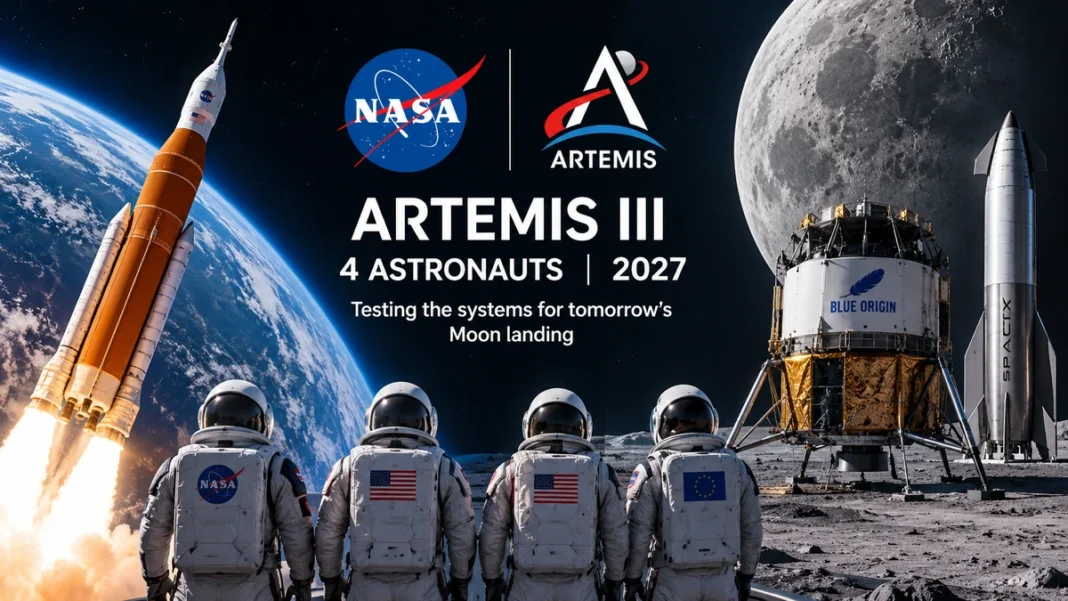
NASA is accelerating preparations for its next phase of lunar exploration, with the Artemis III mission scheduled for 2027 to test critical technologies needed for future human landings on the Moon. The mission will send four astronauts into low Earth orbit to conduct a series of demonstrations involving NASA’s Orion spacecraft and lunar landers developed by private aerospace companies.
The US space agency announced updated mission details on October 23, 2026, outlining how Artemis III will help prepare astronauts and engineers for Artemis IV, which is planned to return humans to the lunar surface in 2028. The programme aims to establish a sustained human presence on and around the Moon, beginning with exploration of its South Pole region.
Artemis III to Test Critical Spacecraft Systems
Unlike a lunar landing mission, Artemis III will focus on testing spacecraft systems and operational procedures in low Earth orbit. NASA plans to launch four astronauts aboard its Orion spacecraft, carried by the Space Launch System (SLS) rocket from Kennedy Space Center in Florida.
The crew comprises NASA astronauts Randy Bresnik, Frank Rubio and Andre Douglas, along with European Space Agency astronaut Luca Parmitano. NASA previously announced the crew assignments in June 2026.
During the planned 14-day mission, astronauts will practise rendezvous and docking operations with test versions of lunar landers being developed by Blue Origin and SpaceX. These demonstrations are intended to assess how different spacecraft communicate, connect and operate together in orbit.
The tests will also examine spacecraft software, guidance systems, communications, life-support functions and crew procedures. NASA expects the results to help engineers identify potential problems and reduce risks before astronauts attempt a lunar landing.
SpaceX and Blue Origin to Play Key Roles
Commercial space companies will have an important role in NASA’s preparations for returning humans to the Moon.
Blue Origin is developing its Blue Moon Mark 2 lunar lander, while SpaceX is developing Starship for human lunar exploration. Both systems are intended to support the Artemis programme, although their designs and operating procedures differ.
According to NASA’s mission plan, the agency intends to evaluate Orion’s ability to rendezvous and dock with a Blue Moon test vehicle and a Starship test article. Astronauts are expected to enter the Blue Moon test vehicle to assess its cabin and relevant systems. The Starship demonstration will focus on docking and integrated spacecraft operations, without the crew entering the vehicle.
The mission will also provide engineers with practical experience coordinating multiple launches, spacecraft and mission-control teams. This is particularly important because the landers must work safely with Orion during future crewed lunar expeditions.
Artemis IV Targets a Return to the Lunar Surface
Artemis III is an essential preparatory step towards Artemis IV, which NASA currently lists as a planned crewed surface-landing mission in early 2028.
Under the Artemis IV plan, four astronauts will travel towards lunar orbit aboard Orion. Two crew members are expected to descend to the Moon’s surface using a human landing system, while the remaining crew members stay in lunar orbit.
The astronauts who land are expected to spend approximately one week near the lunar South Pole, conducting scientific investigations, collecting samples and studying the lunar environment before rejoining their crewmates for the journey back to Earth.
The exact timing of the mission will depend on the readiness of the spacecraft, landers and other supporting systems. Successful development and testing of these technologies will be crucial to NASA’s plans.
Why the Artemis Programme Matters
The Artemis programme is designed to advance lunar science and develop the technologies required for longer-duration human exploration beyond Earth. Its objectives include studying the Moon’s geology, investigating potential resources and establishing capabilities that could support future missions to Mars.
By testing spacecraft and lander systems in Earth orbit before attempting a lunar landing, NASA aims to improve mission safety and operational reliability.
Artemis III will therefore serve as a major technical milestone rather than a Moon landing itself. Its results will help determine how prepared NASA and its commercial partners are to carry out Artemis IV and move closer to a sustained human presence on the lunar surface.