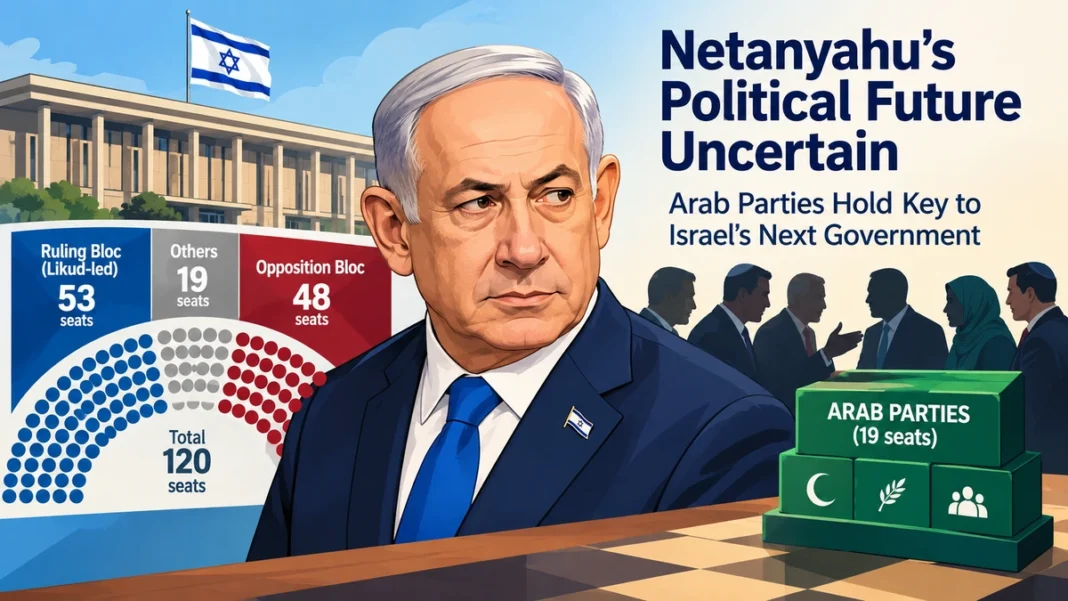
Israel is facing a period of political uncertainty after the final results of its parliamentary elections confirmed that Prime Minister Benjamin Netanyahu’s ruling bloc has lost its majority in the Knesset. The results have placed Arab-led political parties in a decisive position, potentially giving them the power to determine who forms the next government.
According to the final results released on Friday, Netanyahu’s bloc secured 53 seats in the 120-member parliament, while the main opposition bloc won 48 seats. Arab-led parties captured the remaining 19 seats, marking a historic performance and making coalition negotiations crucial for the formation of the next government.
A party or coalition needs at least 61 seats to secure a parliamentary majority. With neither of the two main blocs reaching that threshold, Israel now faces difficult political negotiations involving parties with significantly different ideological positions.
Netanyahu, Israel’s longest-serving prime minister, will remain in office while political parties attempt to reach an agreement on forming a new government.
Arab Parties Emerge as Kingmakers
The strongest development emerging from the election is the increased political influence of Israel’s Arab-led parties. Their combined 19 seats have made them potential kingmakers in the closely contested parliamentary situation.
The main opposition, led by centrist politician Gadi Eisenkot, could potentially reach the required majority by securing the support of Arab-led parties. However, the possibility of such an alliance presents a major political challenge.
Several opposition leaders had previously ruled out depending on Arab parties to form a government. Eisenkot has also expressed reservations about partnering with them, citing differences over national identity and security policies.
However, without their support, the opposition may struggle to secure the 61 seats required to remove Netanyahu’s government from power.
The Arab-led Joint List and Ra’am parties have indicated that they could play a role in facilitating political change. Their support, however, is likely to depend on commitments regarding equality, public safety, funding and the rights of Arab communities in Israel.
The situation has created a political dilemma for the opposition: whether to reconsider its earlier position and work with Arab lawmakers or risk allowing Netanyahu to remain in power.
Netanyahu Rejects Possibility of Alliance with Arab Parties
Netanyahu has strongly opposed the possibility of his political rivals forming a government with Arab-led parties. During the election campaign, he repeatedly portrayed such cooperation as a threat to Israel’s political and national interests.
Following the announcement of the results, Netanyahu and members of his Likud party also amplified allegations that Arab-led parties had influenced the election through irregularities and possible foreign interference.
However, Israel’s election authorities said allegations of systematic violations of electoral integrity were baseless. The election commission clarified that the investigation into possible foreign interference would not affect the final election results or target any particular section of the population.
Qatar, which was reportedly accused by members of Likud of involvement, also rejected the allegations, describing them as dangerous and unfounded.
The controversy has further intensified political tensions between Netanyahu’s supporters and opposition parties, particularly over the participation of Arab citizens in Israel’s democratic process.
President Isaac Herzog to Decide Next Steps
The responsibility for initiating the government formation process will now fall on Israeli President Isaac Herzog.
After the election results are formally certified and submitted, Herzog will consult political representatives before deciding which candidate is most likely to secure sufficient parliamentary support to form a government.
The candidate selected will have to negotiate with different political parties to establish a coalition capable of commanding at least 61 seats in the Knesset.
If the attempts to form a government fail, Israel could face another parliamentary election early next year. Herzog has reportedly expressed his intention to avoid another election and encourage political parties to reach an agreement.
Meanwhile, the newly elected Knesset is expected to convene on November 10. The opposition bloc and Arab-led parties could potentially cooperate to elect a new parliamentary speaker, allowing them to influence the legislative agenda even before a new government is established.
What Lies Ahead for Netanyahu?
The election outcome has placed Netanyahu in one of the most uncertain political situations of his career. Although his Likud-led bloc remains a significant parliamentary force, its failure to secure a majority has weakened his position.
Several possible political arrangements remain under consideration, including an opposition government supported by Arab parties, a broader unity government involving rival political groups, or prolonged negotiations that could eventually lead to another election.
A possible departure from office could also bring renewed attention to the corruption allegations against Netanyahu and questions surrounding security failures before the Hamas-led October 7, 2023, attack on Israel. These issues have remained significant sources of political controversy during his leadership.
For now, the election results have not ended Netanyahu’s premiership, but they have made his political future increasingly dependent on negotiations among parties that have struggled to find common ground.
Israel’s next government will ultimately depend on whether its opposition leaders are willing to reconsider their political commitments and cooperate with Arab-led parties. The coming weeks could therefore prove decisive not only for Netanyahu’s future but also for the country’s political direction.