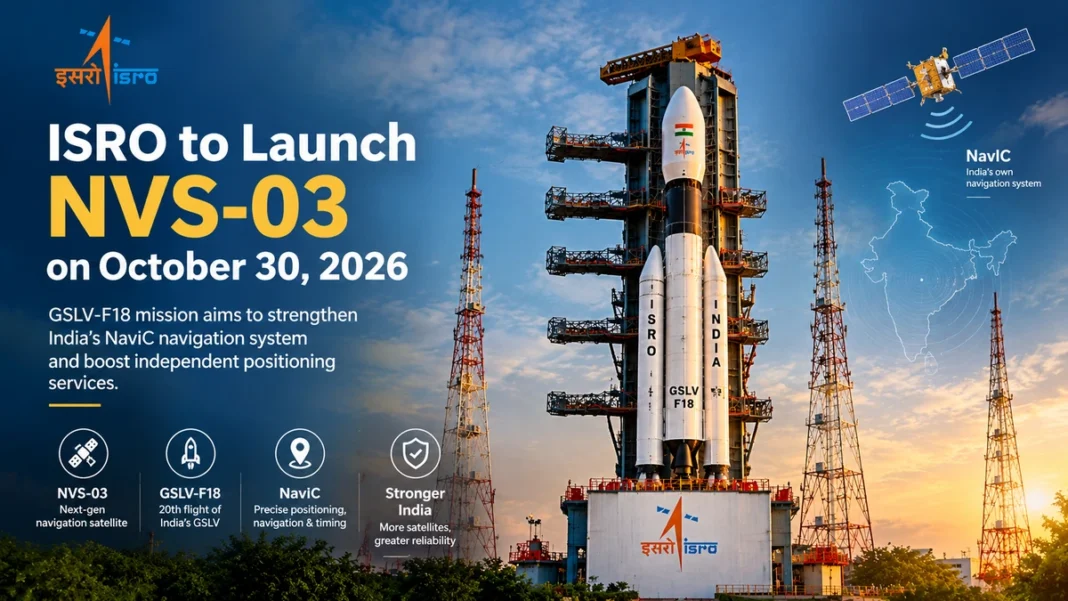
India’s space agency, the Indian Space Research Organisation (ISRO), is preparing to launch its next-generation navigation satellite, NVS-03, aboard the GSLV-F18 rocket on October 30, 2026. The mission aims to strengthen NavIC, India’s indigenous satellite navigation system, at a time when the constellation faces challenges in maintaining independent positioning services.
According to ISRO’s official mission announcement, the launch is scheduled for 11:51 pm IST from the Second Launch Pad at the Satish Dhawan Space Centre in Sriharikota, Andhra Pradesh. The mission will mark the 20th flight of India’s Geosynchronous Satellite Launch Vehicle (GSLV).
The launch is significant not only for the deployment of another satellite but also for India’s efforts to strengthen its independent navigation infrastructure for civilian and strategic applications.
NVS-03: A Key Addition to India’s Navigation Network
NVS-03 is the third satellite in the second-generation NavIC satellite series, designed to maintain continuity and improve the capabilities of India’s regional navigation system.
NavIC, formerly known as the Indian Regional Navigation Satellite System (IRNSS), provides positioning, navigation and timing services across India and an area extending approximately 1,500 kilometres beyond the country’s borders. Its applications include transportation, maritime navigation and other services requiring accurate location and timing information. It also supports strategic requirements.
The approximately 2,250-kilogram NVS-03 satellite will be carried into a Geosynchronous Transfer Orbit (GTO) by the GSLV-F18 launch vehicle. Following deployment, the satellite must complete its orbital manoeuvres before entering its intended operational orbit.
According to ISRO, NVS-03 will carry indigenous atomic-clock technology alongside procured atomic clocks. It will also introduce the L1 navigation signal in addition to the existing L5 and S-band signals, expanding the system’s capabilities.
These improvements are intended to support the continued development of NavIC and help maintain reliable navigation services as India upgrades its satellite constellation.
NVS-02 Setback Makes the Upcoming Launch More Critical
The NVS-03 mission comes after a propulsion-related failure affected its predecessor, NVS-02, which was launched aboard GSLV-F15 on January 29, 2025.
Although NVS-02 successfully reached its initial transfer orbit, it could not complete the manoeuvres needed to reach its intended operational orbit. An investigation found that an electrical signal had failed to reach a pyrotechnic valve in the oxidiser line, preventing the required oxidiser flow to the satellite’s propulsion system.
In a significant engineering change reported by India Today on October 28, ISRO is preparing NVS-03 with its pyrotechnic valves already open before launch. The change is intended to avoid the specific activation failure encountered by NVS-02. However, it also places greater importance on the performance of the remaining propulsion controls and the system’s ability to withstand launch conditions.
The configuration is an important aspect of the upcoming mission, although its effectiveness will ultimately depend on the satellite’s performance during deployment and subsequent orbital manoeuvres.
Why NavIC Matters for India
India’s independent navigation system is important because it provides an alternative to relying entirely on foreign satellite navigation networks, such as the United States’ Global Positioning System (GPS).
NavIC is designed to provide two categories of services: a Standard Positioning Service for civilian users and a Restricted Service for authorised users. Its applications span transport, maritime navigation, location-based services and strategic operations.
The need to strengthen the constellation has become more pressing as the availability of operational satellites has declined. India Today reported on October 24, citing a government response to Parliament, that only three satellites were providing positioning, navigation and timing services through NavIC. Three satellites are insufficient for conventional standalone three-dimensional positioning, which generally requires signals from at least four satellites.
NVS-03 is expected to help address this gap once it reaches its intended orbit and becomes operational. However, the launch alone will not immediately guarantee the restoration of independent positioning services.
ISRO is also developing the subsequent NVS-04 and NVS-05 satellites as part of its broader effort to strengthen the navigation constellation.
What Happens Next?
The immediate milestone is the scheduled October 30 launch. After GSLV-F18 places NVS-03 into geosynchronous transfer orbit, the satellite must use its onboard propulsion system to reach its intended operational orbit before completing commissioning.
The mission’s success will therefore depend on more than a successful rocket launch. The satellite must also complete its orbital manoeuvres and demonstrate that its navigation payload and other critical systems are functioning as intended.
For India, the NVS-03 mission represents another step towards maintaining a reliable, domestically developed navigation network. Its outcome will be closely watched as ISRO works to strengthen NavIC for civilian and strategic use.