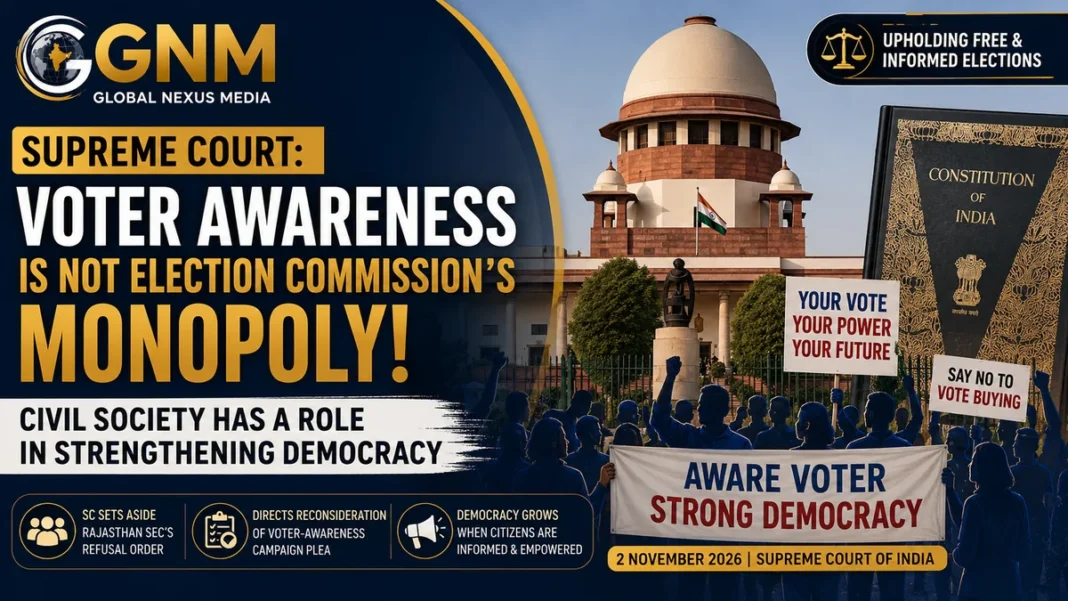
Why the Supreme Court’s latest order on Rajasthan’s local body elections matters for democratic participation, electoral literacy and constitutional governance
By GNM — Global Nexus Media
India’s democracy does not become stronger merely because citizens cast their votes. It becomes stronger when voters understand their rights, recognise electoral malpractice and make informed choices without fear, pressure or inducement.
On 2 November 2026, the Supreme Court of India delivered an important message on this principle while hearing a matter concerning voter-awareness campaigns in Rajasthan.
The Court set aside a communication by the Rajasthan State Election Commission (SEC) that had refused permission to a civil society group to conduct voter-awareness campaigns ahead of local body elections. It directed the Commission to reconsider the request within 48 hours.
The central observation was significant: an election authority cannot claim exclusive control over voter-awareness activities merely because it is already conducting its own programmes.
The development raises an important constitutional and democratic question: Should voter education remain exclusively within the domain of election authorities, or should civil society organisations also be encouraged to strengthen informed participation?
The Supreme Court’s observations support the latter approach, while preserving the election authorities’ power to regulate unlawful or partisan activities.
1. What happened in the Supreme Court?
The matter concerned a request by social activists Aruna Roy and Nikhil Dey, associated with the Mazdoor Kisan Shakti Sangathan (MKSS), and their efforts to conduct voter-awareness campaigns in Rajasthan.Live Law
The campaign, reportedly conducted for around two decades, aims to educate citizens about democratic rights, electoral procedures and responsible voting.
It also seeks to discourage electoral malpractice, particularly the practice of accepting money or other inducements in exchange for votes.
The organisers approached the Rajasthan State Election Commission seeking permission to conduct voter-awareness yatras ahead of the Panchayati Raj elections.
Their requests were rejected.
The Commission reportedly expressed concern that the proposed campaign could be conducted at the behest of another person. It also argued that it was already conducting its own voter-awareness programmes.
The activists challenged the refusal before the Supreme Court.
A Bench comprising Chief Justice of India Surya Kant and Justices Joymalya Bagchi and V. Mohana considered the matter on 2 November 2026.
Justice Joymalya Bagchi emphasised that the Commission’s own awareness programmes could not become a reason to prevent other organisations from undertaking similar initiatives.
The Court clarified that election authorities could regulate corrupt practices conducted under the cover of voter awareness, but could not monopolise such activities.
It set aside the earlier refusal and directed the Rajasthan SEC to reconsider the request within 48 hours.
The important distinction: The Supreme Court did not grant unrestricted permission for every proposed activity. It required the Commission to reconsider the application instead of rejecting it on the grounds that it was already conducting awareness programmes or that voter awareness should be controlled exclusively by the Commission.
2. Why is this order important for Indian democracy?
A. Voter awareness is broader than voter turnout
A successful election is not measured only by the number of people who vote.ECI
A meaningful democratic process also requires voters to understand:
- Their voting rights and electoral choices.
- The importance of independent decision-making.
- The consequences of accepting money or gifts in exchange for votes.
- The electoral process and relevant rules.
- The importance of rejecting intimidation and unfair electoral practices.
Voter awareness can therefore improve the quality of democratic participation, not merely the quantity of votes cast.
B. Civil society can strengthen democratic institutions
Civil society organisations often work directly with communities, particularly in rural and marginalised areas.
They can help bridge the gap between formal electoral institutions and citizens who may have limited access to information.
The Supreme Court’s observations recognise that non-partisan citizen initiatives can complement official voter-awareness programmes.Amit Shah Accuses Congress of Shielding Illegal Immigrants Amid Row Over Voter List Revision
The relationship should be one of cooperation, not unnecessary institutional competition.
C. Election authorities must regulate, not monopolise
Election authorities have a crucial responsibility to protect electoral integrity.
However, regulatory authority should not become a justification for unnecessarily restricting legitimate public participation.
The Court’s approach highlights an important balance:
- Encourage genuine voter education.
- Prevent political campaigning disguised as voter awareness.
- Take action against inducements, misinformation and corrupt practices.
- Apply restrictions on a reasoned and proportionate basis.
This balance is essential to maintaining public confidence in elections.
3. The constitutional framework: Where does the State Election Commission get its power?
An important aspect of this case is the distinction between the Election Commission of India and State Election Commissions.
Both institutions have constitutional status, but their responsibilities are different.
Article 324 — Election Commission of India
Article 324 of the Constitution provides for the superintendence, direction and control of elections to:
- Parliament.
- State Legislatures.
- The offices of President and Vice-President.
The Election Commission of India (ECI) is responsible for these elections.
Article 243K — State Election Commissions
Article 243K provides for the superintendence, direction and control of elections to Panchayats.
It provides for the establishment of a State Election Commission headed by a State Election Commissioner appointed by the Governor.
Article 243ZA — Municipal elections
Article 243ZA provides for the superintendence, direction and control of elections to Municipalities to be vested in the State Election Commission referred to in Article 243K.
Therefore, Rajasthan’s local body elections fall within the constitutional framework governing State Election Commissions.
Why this distinction matters: The present case concerns Rajasthan’s local body elections. It should not be incorrectly described as an order concerning the Election Commission of India’s conduct of Lok Sabha or State Assembly elections.
4. What is the role of civil society in voter awareness?
Civil society includes voluntary organisations, community groups, non-governmental organisations, social movements and other non-state institutions that work for public welfare.
In electoral democracy, such organisations can contribute through:
Electoral literacy: Explaining voting procedures, electoral choices and democratic rights.
Awareness against vote-buying: Informing citizens that votes should not be exchanged for money, gifts or other inducements.
NOTA awareness: Explaining the None of the Above option and its legal meaning.
Community participation: Conducting discussions in villages and local communities.
Democratic accountability: Encouraging citizens to engage with public institutions and understand electoral processes.
However, civil society organisations must also maintain transparency and political neutrality when claiming to conduct non-partisan voter-awareness programmes.
Voter education must not become a disguised mechanism for campaigning for or against a candidate.
5. The regulatory challenge: Where should the line be drawn?
The Court’s observations do not mean that every organisation can conduct any activity during an election period without restrictions.
Election authorities must remain alert to activities that could undermine free and fair elections.
Important concerns include:
- Political neutrality: Awareness programmes must not become indirect campaigning for a particular candidate or political party.
- Electoral inducements: Organisations must not distribute money, gifts or benefits to influence voting behaviour.
- Misinformation: False information about candidates, voting procedures or electoral rules can damage public confidence.
- Public order: Reasonable restrictions may be imposed to maintain public order, provided they are applied lawfully and proportionately.
- Transparency: Organisers should clearly identify the purpose, locations, dates and nature of their proposed activities.
The Supreme Court also indicated that the organisers should specify the places, dates and times of the proposed programmes rather than seek an undefined blanket permission.
The objective is not to remove regulation. It is to ensure that regulation does not unnecessarily suppress legitimate democratic participation.Rally in Delhi: Rahul Gandhi Leads INDIA Bloc’
6. Section 163 of the BNSS: Why did it become relevant?
The dispute also involved prohibitory orders imposed under Section 163 of the Bharatiya Nagarik Suraksha Sanhita (BNSS), 2023.
Section 163 empowers an Executive Magistrate to issue orders in urgent cases of nuisance or apprehended danger when immediate prevention or speedy remedy is desirable.
Such orders may restrict certain activities, including public gatherings, where the statutory conditions are satisfied.
During election periods, public-order restrictions may be considered necessary to prevent disturbances.
However, restrictions must be assessed in accordance with law and the circumstances of the particular case.
The Supreme Court’s approach highlights the need to distinguish between legitimate voter-awareness activities and activities that may threaten public order or electoral fairness.
A restriction should not become a blanket instrument for preventing lawful democratic participation.
7. What does this mean for electoral reforms in India?
India has made significant efforts to improve electoral participation through voter education, awareness programmes and institutional initiatives.
The Election Commission of India has undertaken initiatives such as the Systematic Voters’ Education and Electoral Participation (SVEEP) programme.
The programme focuses on voter awareness, electoral literacy and informed participation.
However, electoral literacy cannot depend only on official campaigns.
India’s democratic structure can benefit from cooperation among:
- Election authorities.
- Educational institutions.
- Civil society organisations.
- Community-based organisations.
- Media institutions.
- Local self-government bodies.
The Supreme Court’s observations reinforce the importance of a participatory approach to democratic education.
The goal should be to create informed voters who can exercise their choices independently.
8. Challenges that remain
Despite the positive democratic message, several challenges require attention.
Unequal access to information: Rural communities, first-time voters and marginalised groups may face barriers to reliable electoral information.
Political influence: Some organisations may claim to conduct awareness programmes while indirectly promoting political interests.
Digital misinformation: Social media platforms can spread false information about candidates, voting procedures and electoral rules.
Institutional coordination: Election authorities need clear procedures for receiving, assessing and deciding applications from civil society organisations.
Public order and electoral integrity: Authorities must maintain security without imposing unnecessarily broad restrictions on legitimate activities.
A transparent and consistent permission mechanism can help address these challenges.
9. The way forward
India needs an electoral-awareness framework based on cooperation, transparency and accountability.
The following measures can strengthen democratic participation:
- Clear permission guidelines: State Election Commissions should establish transparent procedures for non-partisan voter-awareness activities.
- Time-bound decisions: Applications should be decided within reasonable and clearly defined timelines.
- Objective safeguards: Restrictions should be based on specific reasons and the actual nature of the proposed activity.
- Civil society partnerships: Election authorities can collaborate with credible organisations to improve electoral literacy.
- Digital awareness: Verified information about voting rights, NOTA and electoral procedures should be made available in regional languages.
- Action against malpractice: Political campaigning, inducements and misinformation disguised as voter education should be regulated under applicable law.
- Civic education: Schools, colleges and universities should encourage constitutional literacy and responsible democratic participation.
10. Conclusion: Democracy needs informed citizens, not merely polling booths
The Supreme Court’s order of 2 November 2026 is a reminder that democratic participation extends beyond the act of voting.
Election authorities have the constitutional responsibility to protect electoral integrity. Civil society, meanwhile, can play a constructive role in educating citizens and strengthening democratic awareness.
The two roles need not conflict.
The Court has made an important distinction: election authorities can regulate unlawful activities, but their own awareness programmes cannot be used as a reason to claim exclusive control over voter education.
For a country as diverse as India, an informed electorate is one of the strongest foundations of democratic governance.
A healthy democracy does not fear an informed voter. It depends on one.
UPSC SPECIAL: EXAM ORIENTATION
11. Syllabus mapping
| UPSC paper | Relevant syllabus area |
|---|---|
| GS Paper II | Indian Constitution, constitutional bodies, democratic institutions |
| GS Paper II | Devolution of powers and local self-government |
| GS Paper II | Role of civil society and NGOs in development processes |
| GS Paper II | Government policies and interventions |
| GS Paper IV | Ethics in public administration, integrity and impartiality |
| Essay | Democracy, informed citizenship and participatory governance |
12. Important constitutional and legal provisions
| Provision | Significance |
|---|---|
| Article 324 | Superintendence, direction and control of specified national and State-level elections by ECI |
| Article 243K | State Election Commission for Panchayat elections |
| Article 243ZA | State Election Commission for Municipal elections |
| Article 19(1)(a) | Freedom of speech and expression |
| Article 19(1)(c) | Right to form associations or unions |
| Article 19(2) | Permissible reasonable restrictions on freedom of speech and expression |
| Section 163, BNSS | Urgent orders in cases of nuisance or apprehended danger |
Important: The Supreme Court’s order in this case should not be described as declaring an unrestricted fundamental right to organise any election-period campaign. The Court set aside the particular refusal and required reconsideration, while recognising the election authority’s regulatory role.
13. Key terms for Prelims
- SVEEP: Systematic Voters’ Education and Electoral Participation.
- NOTA: None of the Above.
- SEC: State Election Commission.
- ECI: Election Commission of India.
- Electoral literacy: Understanding of electoral rights, procedures and democratic responsibilities.
- Civil society: Organisations and groups operating outside the formal State structure that participate in public and community affairs.
- Panchayati Raj: Constitutional system of rural local self-government under Part IX of the Constitution.
14. Prelims practice questions
Question 1. With reference to the State Election Commission in India, consider the following statements:
- Article 243K provides for the State Election Commission for Panchayat elections.
- Article 243ZA deals with elections to Municipalities.
- The Election Commission of India directly supervises all Panchayat elections in the States.
Which of the statements given above is/are correct?
A. 1 only
B. 1 and 2 only
C. 2 and 3 only
D. 1, 2 and 3
Answer: B — 1 and 2 only.
Explanation: Panchayat and Municipal elections are under the constitutional framework of State Election Commissions, not the direct supervision of the ECI.
Question 2. Consider the following statements regarding NOTA:
- NOTA stands for None of the Above.
- A voter can use NOTA to indicate that they do not wish to vote for any of the listed candidates.
- NOTA automatically results in the cancellation of an election if it receives the highest number of votes.
Which of the statements given above is/are correct?
A. 1 and 2 only
B. 2 and 3 only
C. 1 and 3 only
D. 1, 2 and 3
Answer: A — 1 and 2 only.
Explanation: NOTA allows voters to express rejection of all listed candidates. It does not automatically invalidate an election merely because it receives the highest number of votes.
Question 3. Article 243ZA of the Constitution is associated with:
A. Appointment of the Governor
B. Elections to Municipalities
C. Powers of the Finance Commission
D. Elections to Parliament
Answer: B — Elections to Municipalities.
Explanation: Article 243ZA provides for the superintendence, direction and control of Municipal elections by the State Election Commission.
15. Mains practice
Question — GS Paper II (15 marks, 250 words)
“An informed electorate is essential for strengthening democratic accountability. Examine the role of civil society organisations in voter awareness in the light of the Supreme Court’s recent observations concerning the Rajasthan State Election Commission.”
Model answer
A vibrant democracy requires more than periodic elections. It requires citizens who understand their voting rights, electoral procedures and responsibilities.
On 2 November 2026, the Supreme Court set aside the Rajasthan State Election Commission’s refusal to permit a civil society group to conduct voter-awareness campaigns and directed the Commission to reconsider the request within 48 hours. The Court observed that election authorities cannot monopolise voter-awareness initiatives merely because they conduct their own programmes.
Role of civil society organisations:
- Electoral literacy: Educating citizens about voting procedures, NOTA and democratic rights.
- Preventing malpractice: Creating awareness against vote-buying, intimidation and electoral inducements.
- Grassroots participation: Reaching rural and marginalised communities through local campaigns.
- Democratic accountability: Encouraging informed public participation and awareness of electoral institutions.
Constitutional significance:
Articles 243K and 243ZA provide for State Election Commissions to supervise Panchayat and Municipal elections. Their authority to regulate elections must be exercised consistently with democratic principles and applicable law.
Challenges:
- Political neutrality of awareness organisations.
- Misinformation and disguised campaigning.
- Public-order concerns during election periods.
- Lack of uniform permission procedures.
Way forward: State Election Commissions should develop transparent, time-bound permission mechanisms, encourage credible civil society partnerships and take action against electoral malpractice.
Conclusion: Election authorities must protect electoral integrity while enabling informed public participation. A cooperative approach between constitutional institutions and civil society can strengthen the foundations of Indian democracy.