

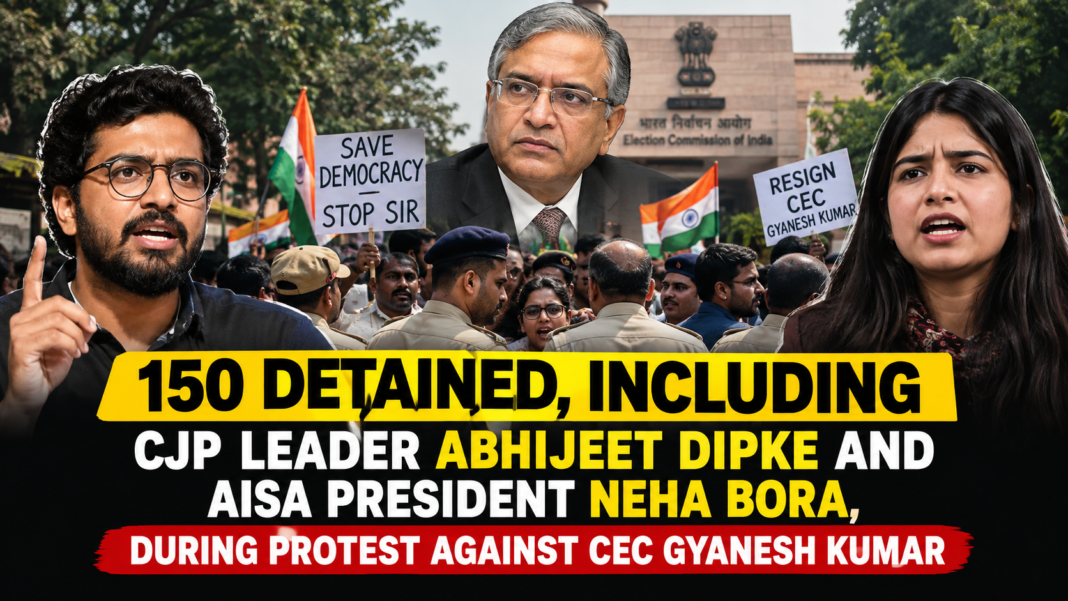
NEW DELHI: At least 150 people were detained in Delhi during protests against Chief Election Commissioner (CEC) Gyanesh Kumar, triggering criticism from opposition leaders and raising questions about the handling of demonstrations in the national capital. Among those detained were Abhijeet Dipke, founder of the Cockroach Janta Party (CJP), and Neha Bora, president of the All India Students’ Association (AISA).
The demonstrations, organised under the campaign Lehra Do Tiranga, were linked to concerns over the Election Commission of India’s Special Intensive Revision (SIR) of electoral rolls. Protesters demanded Kumar’s resignation, alleging irregularities in the voter-list revision process. Police, meanwhile, cited restrictions on public gatherings and the need to maintain law and order.
Detentions Across Central Delhi
According to reports by Hindustan Times, Dipke was detained while travelling from his residence in Jhandewalan towards Connaught Place, where protesters had planned to gather. Police had reportedly served him a notice advising him against joining the proposed march.
Bora was detained at Mandi House while heading towards the demonstration. Other protesters were also detained at different locations across central Delhi.
Police cited prohibitory orders under Section 163 of the Bharatiya Nagarik Suraksha Sanhita (BNSS), which permits restrictions on certain activities when immediate measures are considered necessary to prevent potential danger or disturbance to public order. Authorities maintained that the proposed gathering lacked the required permission and that restrictions were necessary to prevent disruption.
Demonstrators nevertheless gathered at locations including Connaught Place, Janpath Road and Mandi House, carrying national flags and raising slogans. Reports also described jostling involving protesters, journalists and police as officers moved to disperse gatherings.
Why Are Protesters Opposing SIR?
At the centre of the controversy is the Special Intensive Revision, an exercise undertaken by the Election Commission to review and update electoral rolls.
The Commission’s stated objective is to maintain accurate voter lists by identifying errors and verifying voter eligibility. However, the exercise has drawn criticism from political parties and civil-society groups concerned about the potential exclusion of eligible voters.
Critics argue that extensive verification requirements could disproportionately affect economically disadvantaged citizens, migrant workers and other people who face difficulties producing documents or accessing administrative services. They have also raised concerns about transparency and the mechanisms available to challenge the removal of names from electoral rolls.
These concerns are particularly significant in a democracy where inclusion on the electoral roll is essential to exercising the right to vote.
However, allegations of wrongful exclusion must be assessed against verifiable evidence, including voter records, official data, complaints from affected individuals and the Election Commission’s responses. The existence of a controversy does not, by itself, establish that electoral wrongdoing has occurred.
Opposition Criticises Police Action
The detentions prompted criticism from opposition leaders, including West Bengal Chief Minister Mamata Banerjee, Aam Aadmi Party leader Arvind Kejriwal and Tamil Nadu Chief Minister M. K. Stalin, according to media reports.
Their criticism focused on the police response to the demonstrations and concerns about the treatment of those detained.
The incident also raised questions about the whereabouts of the detained activists. In subsequent reporting, AISA associates expressed concern about Bora’s location and access to necessary assistance. A follow-up report by Hindustan Times stated that lawyers were eventually able to meet her at RK Puram police station around midnight. CJP, meanwhile, continued to raise questions about Dipke’s whereabouts.
These developments underline the importance of timely information about detention, access to legal assistance and clear communication between authorities, detainees and their representatives. Allegations concerning the treatment of those detained require responses from the relevant authorities and independent verification.
Balancing Public Order and Democratic Rights
The episode brings the relationship between public order and democratic freedoms into focus. Article 19(1)(a) of the Indian Constitution guarantees freedom of speech and expression, while Article 19(1)(b) protects the right to assemble peacefully and without arms. Both rights are subject to constitutionally permitted restrictions.
Authorities can regulate demonstrations under the law, particularly where public safety and order are at stake. However, the existence of restrictions does not automatically settle whether every detention was necessary, proportionate or legally justified.
A fuller assessment would require examination of the relevant police orders, the specific grounds for each detention, the duration of custody and whether applicable procedural safeguards were followed.
Similarly, the concerns surrounding the voter-list revision require scrutiny of official data, the experiences of affected voters and the procedures available to correct errors.
Questions Remain
The detentions have brought renewed attention to the controversy surrounding electoral-roll revision and the space available for citizens to express dissent.
Key questions remain about the precise grounds for individual detentions, the subsequent legal status of those held and the evidence supporting allegations of wrongful voter exclusion. Responses from Delhi Police and the Election Commission are essential to establishing a complete account.
Ultimately, the issue extends beyond a single protest. It concerns public confidence in electoral administration and the ability of citizens to raise concerns through peaceful democratic participation. Establishing the facts through transparent procedures, independent scrutiny and accountable institutions will be crucial to resolving the questions raised by the incident.