The Leader of the Opposition backs students, questions the state of democracy and puts examination fairness, unemployment and Tamil Nadu’s educational identity at the centre of a charged public address.
By Global Nexus Media | 11 October 2026 | National Politics & Education
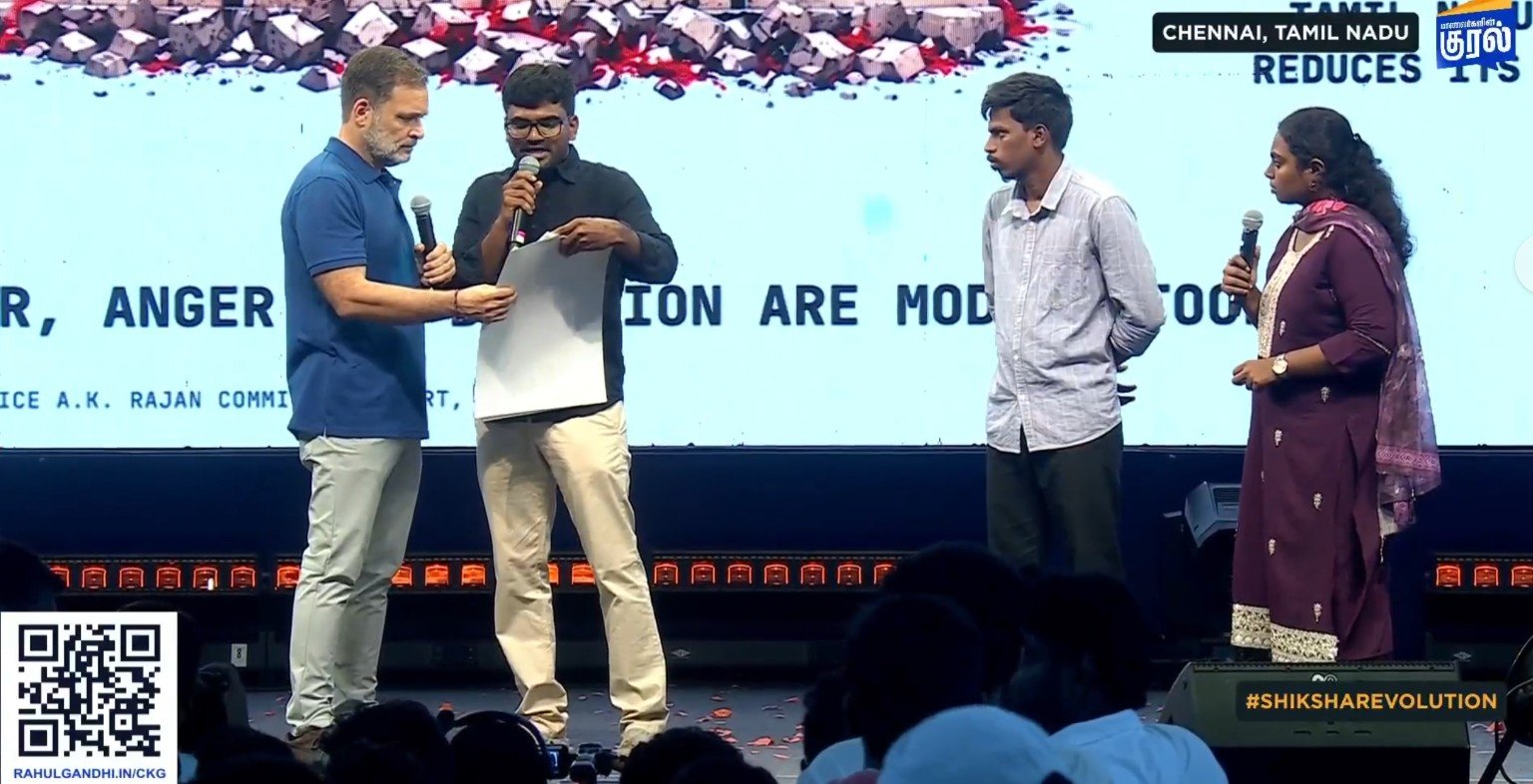
CHENNAI: “Together, we will demolish Modi.” With this politically charged declaration, Congress leader and Leader of the Opposition in the Lok Sabha Rahul Gandhi delivered one of the most striking lines of his address at Chhatron Ki Goonj, a student outreach programme held at Island Grounds in Chennai on 10 October 2026.
The statement formed part of Gandhi’s broader attack on Prime Minister Narendra Modi and the BJP-led government. Addressing a gathering focused on student concerns, he also urged young people not to stop asking questions, connecting the freedom to question authority with his argument about democracy, education and public accountability.
The sixth edition of Chhatron Ki Goonj, also promoted in Tamil as Manavargalin Kural—the voice of students—brought together political debate and the concerns of young people navigating India’s competitive education system. According to India Today’s event coverage, students from institutions including Loyola College, Women’s Christian College, Madras Christian College and Pachaiyappa’s College were among those attending.
The programme placed several pressing issues in the spotlight: NEET, examination irregularities, the financial burden of coaching, unemployment, language policy and the relationship between students and public institutions.
For Gandhi, the gathering provided a platform to connect these everyday concerns with a wider political argument. For students, the issues extend well beyond party politics: they concern the fairness of examinations, the affordability of education and the opportunities available after graduation.

‘Never Stop Asking Questions’: Rahul Gandhi’s Message to Students
Beyond the headline-making political remarks, a central theme of Gandhi’s address was the importance of curiosity and independent thinking.Rahul Gandhi X
His appeal to students to keep questioning connected education with a broader democratic principle: learning should involve examining evidence, challenging assumptions and seeking explanations rather than accepting every claim without scrutiny.
The message resonated with the programme’s stated focus on educational challenges. Students preparing for competitive examinations often face intense pressure, financial commitments and uncertainty over their future prospects. Their concerns can include the fairness of selection procedures, recruitment delays, the quality of education and the cost of coaching.
Gandhi’s argument placed these experiences within a wider discussion about accountability. Educational institutions and public authorities, in this view, should be prepared to explain their decisions and respond to legitimate questions.
The principle has relevance beyond any one political party. Independent thinking is essential to education, while transparent institutions are important to public confidence.
The real challenge is to translate encouragement into practice: classrooms that welcome questions, examination systems that inspire confidence and grievance mechanisms that provide meaningful responses.https://www.youtube.com/@IndianNationalCongress
Rahul Gandhi’s ‘Demolish Modi’ Remark: What Did He Mean?
Gandhi’s sharpest political remarks targeted Prime Minister Narendra Modi and the BJP-led government.
According to The Economic Times’ report on the event, Gandhi said Modi did not understand that “the game is over” and concluded his appeal to students with the words, “together we will demolish Modi.” He also criticised the government’s handling of protests in Delhi and alleged that democratic institutions and dissenting voices were being undermined.Economics Time Report
These statements were political allegations and expressions of Gandhi’s opposition to the government, not independently established findings about the Prime Minister or the state of democratic institutions.
The significance of the remarks lies in the way Gandhi connected his political confrontation with his appeal to young people. He presented students not merely as observers of political competition but as citizens entitled to ask questions about government decisions and institutional accountability.
The language was confrontational, but the underlying political dispute concerns substantive questions: how authorities respond to protests, how elections and public institutions are scrutinised, and how citizens can seek accountability when they believe their rights have been affected.
For a news audience, the distinction matters. Gandhi’s words are newsworthy because of the position he holds and the strength of his criticism. The claims themselves must still be assessed against independent reporting, documentary evidence and the responses of the institutions concerned.
NEET, Paper Leaks and the Pressure on India’s Students
One of the most consequential themes surrounding Chhatron Ki Goonj is the pressure created by competitive examinations.
For aspiring medical students, NEET can determine access to years of professional training. Preparing for such examinations may involve expensive coaching, study materials and long periods of intensive preparation. For families with limited resources, these costs can make an already competitive process more difficult.
Concerns about alleged paper leaks, examination security, selection procedures and the fairness of admissions therefore deserve careful investigation. Allegations of wrongdoing should be examined individually, and any confirmed irregularities should be addressed through transparent procedures.
The problem is not confined to medical entrance examinations. Candidates across India prepare for engineering entrance tests, civil services examinations and public-sector recruitment processes. They need reliable schedules, clear selection criteria, secure examinations and timely communication.
Gandhi’s student outreach has highlighted these issues as part of a wider criticism of India’s education system. His political assessment is contested, but the practical questions facing students warrant sustained public attention.
A credible response requires more than political promises. It requires examination bodies that communicate clearly, investigate complaints fairly and demonstrate that candidates are being treated according to published rules.
Education and Employment: The Gap Between Qualifications and Opportunity
For India’s young population, education is closely linked to the prospect of employment and economic independence.
Yet a degree does not automatically guarantee a suitable job. Outcomes depend on the quality of education, the relevance of skills, the availability of vacancies, economic conditions and the connection between academic institutions and employers.
This makes youth employment a broader policy challenge rather than an issue that can be resolved through a single speech or programme.
Students need access to useful career guidance, practical training, apprenticeships and transparent recruitment. Colleges and universities need strong links with workplaces, while policymakers must consider how economic growth can generate opportunities for new entrants to the labour market.
The discussion at Chhatron Ki Goonj brought educational access and employment into the same conversation. It highlighted the expectation that education should prepare students not only to obtain qualifications but also to build sustainable careers.
The important test for any political proposal is whether it identifies specific measures, explains how those measures will be implemented and provides evidence of their results.
Tamil Language, Cultural Identity and the Education Policy Debate
Gandhi’s Chennai address also touched on Tamil Nadu’s linguistic and cultural identity.
He criticised the Union government’s language and education policies, arguing that Tamil Nadu’s traditions and regional priorities must be respected. His remarks reflected a long-running debate over the National Education Policy, the role of Hindi and the balance of authority between the Union and state governments.
The question is particularly significant in Tamil Nadu, where language is closely connected with cultural history and political identity.
At the same time, educational policy must address practical concerns: whether students can learn effectively, access quality teaching materials and pursue opportunities without unnecessary barriers.
A constructive national debate should consider how common educational standards can coexist with regional languages, local histories and state-level priorities. It should also distinguish the provisions of a policy from competing political interpretations of its likely effects.
Gandhi’s criticism placed these questions within his wider argument for federalism and the protection of Tamil Nadu’s cultural identity. The government’s policies and Gandhi’s claims about their intentions should be evaluated separately, using official documents and independently verified evidence.
For students, the ultimate concern is whether educational arrangements provide meaningful choice, support effective learning and maintain fair access to opportunities.
Inside Chhatron Ki Goonj: A Campaign Focused on Student Concerns
Chhatron Ki Goonj is part of Rahul Gandhi’s student outreach initiative, which has previously organised programmes in cities including Kota, Dehradun, Prayagraj, Pune and Indore.
The campaign’s official website identifies concerns such as paper leaks, the cost of education, unemployment and examination pressure. Its stated objective is to encourage students to raise their voices and participate in a discussion about the education system.
The Chennai event extended this initiative to Tamil Nadu, bringing student concerns into a regional context shaped by debates over NEET, language and educational policy.
For the Congress, the programme also provides an opportunity to communicate its political positions and engage with a younger audience. That context is relevant when assessing the event: student outreach can serve both as a public forum and as a form of political engagement.
Its lasting value will depend on what happens after the gathering. Are student concerns documented? Are specific proposals developed? Do political representatives follow up? Can students assess whether any commitments have led to improvements?
Those questions matter regardless of the political affiliation of the organisers.
Why the Chennai Address Matters in India’s Political Debate
Gandhi’s remarks brought together two subjects that frequently intersect in public life: the future of India’s young people and the role of political institutions.
Education and employment affect individual aspirations, family finances and social mobility. Questions about electoral accountability, public administration and the right to dissent influence how citizens understand their relationship with government.
By linking student concerns with his criticism of the Modi government, Gandhi presented his case that young people should play an active role in public life.
That is a political argument, and readers may assess it differently depending on their views and the evidence they consider. The broader issues, however, call for examination beyond party lines.
Students benefit when examinations are fair, recruitment processes are transparent, educational opportunities are accessible and institutions respond to legitimate grievances. These outcomes require continuing attention from governments, educational authorities, employers and civil society.
The Chennai gathering offered a platform for these concerns to be discussed. Whether it produces lasting change will depend on the proposals, decisions and follow-up that come after the event.
From Political Headlines to Measurable Outcomes
The strongest measure of a student-focused initiative is not the intensity of its slogans but the progress it helps generate.
Several priorities emerge from the issues associated with Chhatron Ki Goonj:
- Fair examinations: Secure testing procedures, transparent investigations and clear communication with candidates.
- Affordable education: Better access to quality learning resources and attention to the financial pressures on families.
- Transparent recruitment: Published schedules, clear selection criteria and timely updates.
- Employment opportunities: Stronger links between education, practical skills, apprenticeships and employers.
- Responsive institutions: Accessible grievance procedures and explanations for important decisions.
- Respect for linguistic diversity: Educational arrangements that account for regional languages and local priorities while maintaining access to wider opportunities.
These are practical objectives that require planning, implementation and oversight. Political leaders can bring attention to them, but institutions must demonstrate whether proposed measures work.
The next stage of the debate should therefore focus on evidence, policy details and the experiences of students themselves.
Conclusion: The Questions Students Ask Must Outlast the Headlines
Rahul Gandhi’s Chhatron Ki Goonj address in Chennai attracted attention for its direct attack on Prime Minister Narendra Modi. His declaration that “together we will demolish Modi” became a headline-making expression of political opposition, while his appeal to students not to stop asking questions provided a broader theme for the gathering.
The programme also brought education, NEET, examination fairness, employment and Tamil Nadu’s linguistic identity into the national conversation.
These issues deserve scrutiny on their merits. Political claims require verification, educational concerns require practical responses, and public institutions must be judged by their decisions and outcomes.
For India’s students, the central questions remain straightforward: Can they trust the examination process? Can they access quality education without excessive financial pressure? Will their qualifications lead to meaningful opportunities? Can they seek explanations when institutions make decisions that affect their future?The Gandhi Problem:
The answers will not emerge from one political event. They will depend on sustained public debate, effective policy and measurable results.
In Chennai, Rahul Gandhi used Chhatron Ki Goonj to combine a forceful political challenge with an appeal for students to keep questioning. The enduring test of the programme will be whether the concerns voiced there lead to concrete improvements in the educational opportunities available to India’s young people.