

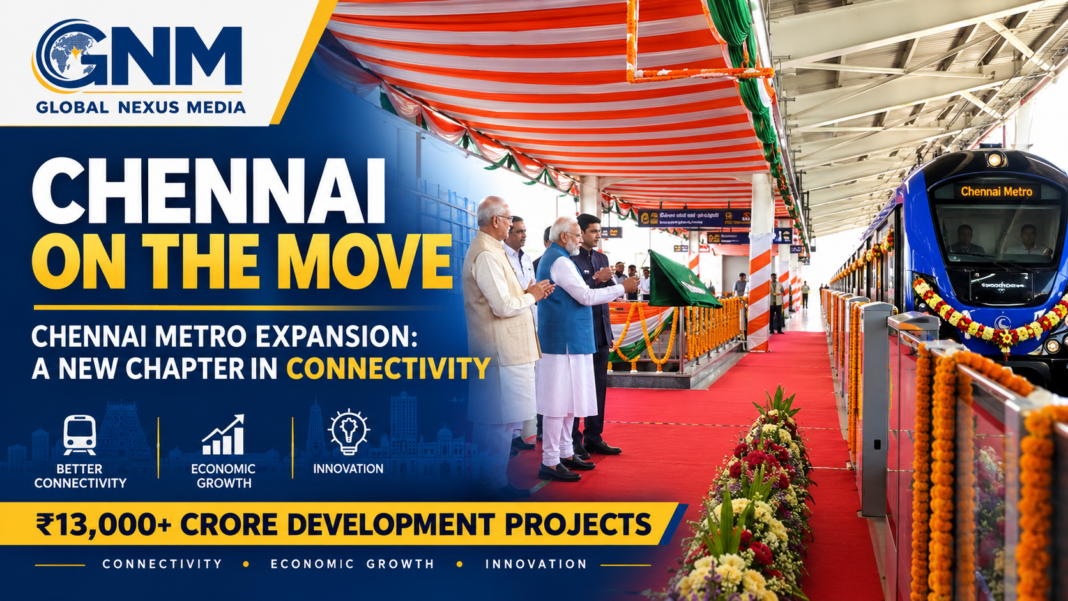
From Chennai Metro and port infrastructure to scientific research at IIT Madras, Prime Minister Modi’s Chennai Visit October 11 raises important questions about development, regional identity and Centre–State relations.
By GNM News Desk | October 11, 2026
CHENNAI: A metro inauguration, a series of infrastructure projects and a visit to a leading scientific research institution—Prime Minister Narendra Modi’s visit to Chennai on October 11 brought several dimensions of Tamil Nadu’s development agenda into focus.
According to the Prime Minister’s Office and the Press Information Bureau (PIB), the programme included development projects worth more than ₹13,000 crore across transport, highways, railways, ports, petroleum infrastructure and scientific research.Prime Minister
Yet the significance of such a visit cannot be measured by the investment figure alone. The more important questions concern what these projects could mean for ordinary citizens, how effectively they will be implemented and how development initiatives fit into Tamil Nadu’s distinctive political landscape.
For a state with a strong industrial base, a significant maritime economy and a political tradition shaped by the Dravidian movement, infrastructure development is closely connected to questions of economic opportunity, regional identity and relations with the Union government.
This makes the Chennai visit worth examining beyond the announcements made at the event.
₹13,000 Crore in Projects: The Difference Between Announcements and Outcomes
The headline figure of more than ₹13,000 crore provides a sense of the scale of the programme. However, the amount alone does not establish the eventual economic impact of the projects.
The visit’s official programme covered several sectors, including road transport, railway infrastructure, port facilities, petroleum infrastructure and scientific research. Each has a different potential impact on the state’s economy.
Improved roads can reduce travel times and facilitate the movement of goods. Better railway connections can strengthen links between industrial centres and markets. Port infrastructure can improve cargo-handling capacity, while investment in research can contribute to long-term scientific development.
However, these benefits depend on implementation, operational efficiency, utilisation and the needs of local communities.
It is also important to distinguish between projects inaugurated for use, facilities formally dedicated to the nation and projects for which foundation stones are laid. These categories represent different stages of development and should not be treated as equivalent.
The central question is therefore not simply how much money has been announced, but how much measurable benefit these investments eventually deliver.
Chennai Metro: Will Better Connectivity Change Everyday Life?
One of the most prominent elements of the visit was the inauguration of the Poonamallee–Vadapalani stretch of Chennai Metro’s Phase II project.

The stretch was reported to be approximately 15 kilometres long, with a project cost of around ₹4,900 crore. The infrastructure includes an approximately 3.7-kilometre double-decker section and modern signalling designed to support future driverless operations.
For residents of a growing metropolitan region, the importance of an urban transport project extends well beyond the inauguration ceremony.
Reliable metro services can reduce dependence on road transport, improve access to workplaces and educational institutions, and potentially make daily commuting more predictable. Better connections can also support commercial activity along the corridors they serve.
But the actual impact will depend on passenger numbers, service frequency, fares, interchange facilities and the integration of the metro with buses and other transport services.
The long-term success of the project will therefore be measured not by the ceremony itself, but by the difference it makes to the daily lives of Chennai’s commuters.
Roads, Railways and Ports: Understanding Tamil Nadu’s Economic Geography
Tamil Nadu’s economic strength is distributed across multiple urban centres, industrial clusters and coastal trading hubs. Efficient connections between these locations are essential for businesses and workers alike.
The official programme included national highway projects, railway infrastructure improvements and facilities connected with Chennai Port, Kamarajar Port and V.O. Chidambaranar Port.
The highway programme included sections associated with National Highway 744 and the Madurai Ring Road, along with a foundation stone for the Tiruvarur bypass. Railway initiatives included the Karaikal–Peralam railway line, railway flyovers in the Coimbatore region and the redevelopment of stations under the Amrit Bharat Station Scheme.
Port-related initiatives were intended to improve infrastructure and operational facilities.
These projects have the potential to strengthen the movement of passengers and freight. Better road and rail access can help businesses move goods more efficiently, while improved port facilities can support cargo-handling operations and maritime trade.
However, the extent of these benefits will depend on actual traffic, freight volumes, operating costs and the ability of industries to use the improved infrastructure.
For that reason, the economic impact of the programme should be assessed over time through measurable indicators rather than inferred solely from project announcements.
IIT Madras: Why Scientific Research Belongs in the Development Debate
Infrastructure is not limited to roads, railways and ports. Scientific research is another important component of a region’s long-term development.
The official programme included a visit to the Sudha Gopalakrishnan Brain Centre at IIT Madras and the dedication of the centre to the nation. The programme also referred to research initiatives involving three-dimensional mapping of the human brain and the release of a C-STROKE atlas.
According to the official announcement, the brain-mapping initiative aims to develop detailed three-dimensional atlases based on more than 100 human brain specimens.
Such research can contribute to the understanding of brain structure and support future work in neuroscience. Its scientific value, however, must be assessed through research outputs, collaboration, reproducibility and its longer-term contribution to knowledge.
The inclusion of a research institution in a programme dominated by infrastructure projects highlights a broader point: development also involves building scientific capacity and supporting knowledge creation.
The results of such investments may take years to become fully visible, making sustained research and institutional support particularly important.
Modi and Tamil Nadu: Why the State’s Political Context Matters
Tamil Nadu occupies a distinctive place in Indian politics. Its political history has been shaped by the Dravidian movement, debates over language, social justice, regional identity and the distribution of powers between the Union and state governments.
These traditions influence how political parties communicate with voters and how policy initiatives are received.
For national political leaders, engagement with Tamil Nadu therefore involves more than announcing infrastructure projects. It also requires an understanding of the state’s historical experiences, social priorities and political institutions.
Development initiatives can create opportunities for cooperation between the Union government and the state administration. At the same time, differences over language, education, fiscal relations and state autonomy may continue to shape political debate.
The two are not mutually exclusive. Governments can cooperate on particular projects while disagreeing on other policy questions.
This distinction is essential to understanding the political significance of Modi’s visit without reducing it either to a political spectacle or to evidence of a broader political realignment.
Vijay, Modi and Rahul Gandhi: What Can the Recent Meetings Tell Us?
The political context surrounding the visit also attracted attention because of Chief Minister C. Joseph Vijay’s public engagements with national leaders.https://x.com/narendramodi
Media reports published around October 10 described a meeting between Congress leader Rahul Gandhi and Chief Minister Vijay in Chennai. The following day, Vijay appeared alongside Prime Minister Modi during the metro programme.
Taken together, these events provide an opportunity to examine the relationship between state-level governance and national political engagement.
However, public meetings and joint appearances do not, by themselves, establish the existence of a new alliance, an electoral arrangement or a change in political strategy.
A more reliable assessment would require further evidence, including official statements, policy decisions, party announcements and subsequent political developments.
The immediate significance is narrower but still relevant: the state government’s relationship with national political figures is an important part of the wider political environment in which development projects are implemented.
Development and Electoral Politics Are Not the Same Thing
Large infrastructure projects can become part of a government’s public record. They may influence how citizens evaluate governance, particularly when the benefits are visible in their daily lives.
But an infrastructure announcement is not proof of electoral support, just as a public appearance is not proof of political agreement.
Tamil Nadu’s electoral behaviour must be understood through actual election results, constituency-level patterns, voter concerns and the wider political context.
The state’s regional political traditions also mean that national political narratives cannot automatically be assumed to translate into electoral outcomes.
For this reason, the political consequences of the Chennai visit should be treated as an open question rather than a predetermined conclusion.
The more useful approach is to examine whether the projects are completed, whether citizens experience tangible improvements and whether the Union and state governments maintain effective coordination.PIB
What Should Be Measured After the Visit?
The real assessment of the visit will begin after the ceremonies.
Three sets of indicators deserve attention.
First, public benefits: Do the new transport facilities reduce commuting time? Are road connections improving accessibility? Are railway and port facilities being used effectively?
Second, economic outcomes: Do businesses experience better freight movement and lower logistical constraints? Does improved connectivity support industrial activity? Do research institutions generate meaningful scientific outputs?India Is Growing Strong. Inflation Is Rising. RBI Turns to “Calibrated Tightening
Third, administrative coordination: Are projects completed according to their schedules? Are operational responsibilities clearly defined? Is coordination between the Union and state governments effective?
These questions require follow-up reporting, official data and, where possible, independent assessments of project performance.
They also provide a practical framework for future coverage of the projects announced or inaugurated during the visit.
Conclusion: The Visit Is One Day; Its Impact Must Be Measured Over Time
Prime Minister Narendra Modi’s October 11 visit to Chennai brought transport infrastructure, industrial connectivity, port development and scientific research into a single public programme.PMO, PIB
Its significance lies not only in the scale of the announced investments, but also in the opportunity to examine how infrastructure, regional identity and Centre–State relations interact in Tamil Nadu.
The visit provides a snapshot of development priorities. It does not, by itself, establish the long-term economic or political consequences of those priorities.
Those consequences will become clearer as projects enter regular operation, citizens begin using the facilities and reliable evidence emerges about their impact.
For journalists, policymakers and citizens alike, the most important question is therefore straightforward: Will the projects associated with the visit translate into measurable improvements in the lives of people across Tamil Nadu?
That is the question worth following long after the inauguration ceremonies have ended.
—GNM News Desk