Category: UPSC Special → Economy
GS Papers: GS III — Banking and Financial Sector; GS II — Judiciary and Regulation
Focus: Current Affairs + Static Concepts + Prelims Practice
Why in News?
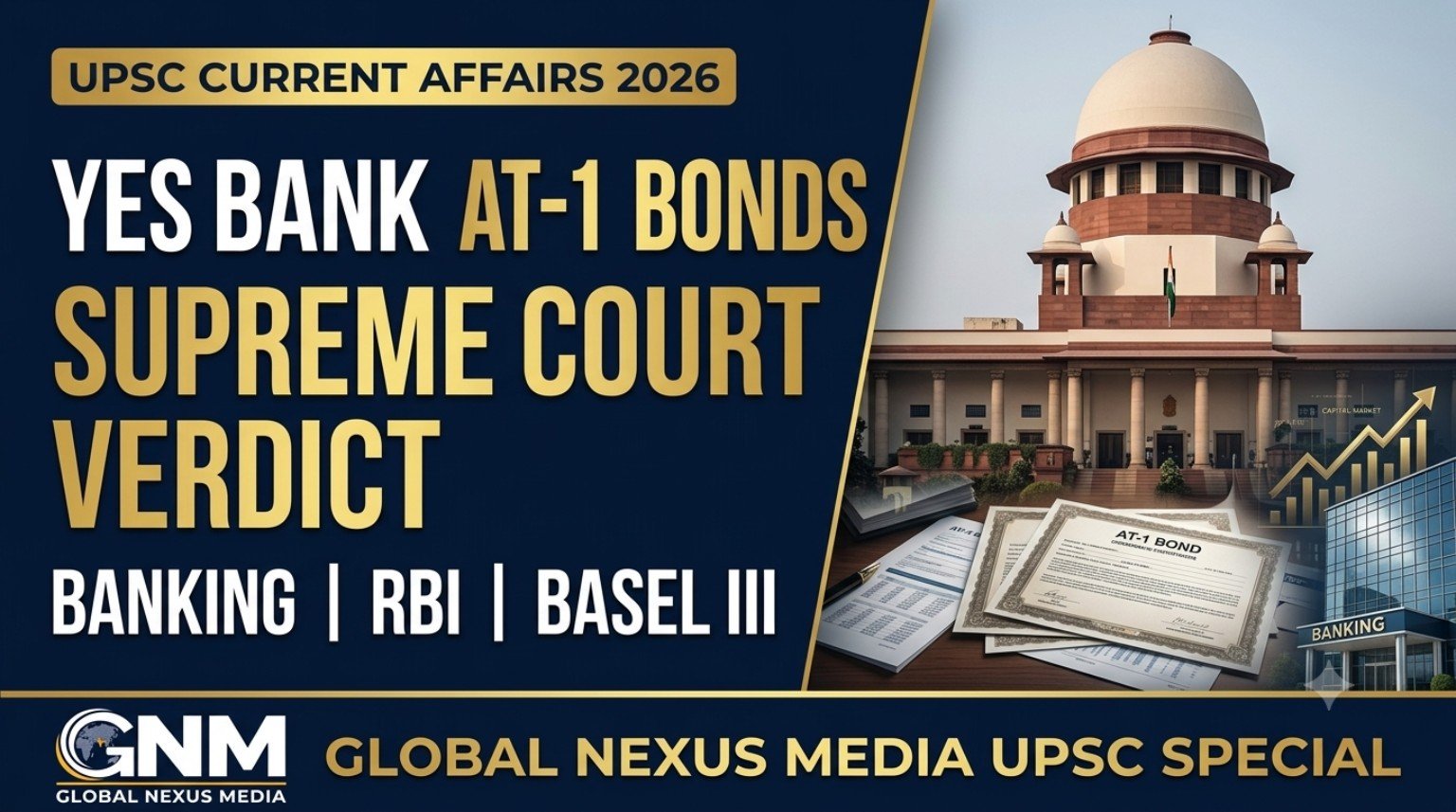
On 15 October 2026, the Supreme Court of India rejected appeals challenging the Bombay High Court’s decision to invalidate the 2020 write-off of ₹8,415 crore worth of YES Bank’s Additional Tier-1 (AT-1) bonds.
The dispute arose from the bank’s reconstruction during its financial crisis in 2020. The Supreme Court’s decision has brought renewed attention to the legal framework governing bank reconstruction, the loss-absorbing role of AT-1 bonds, investor protection and the regulatory responsibilities of the Reserve Bank of India (RBI).
The case is important for UPSC aspirants because it connects banking regulation with financial stability, judicial review and the protection of investors.
Current-affairs source: Reuters — Supreme Court ruling on YES Bank AT-1 bonds, 15 October 2026
What Happened in the Case?
- In March 2020, YES Bank faced a serious financial crisis and was placed under a reconstruction process.
- As part of the reconstruction, ₹8,415 crore worth of AT-1 bonds were written off on 14 March 2020.
- Bondholders challenged the write-off.
- In January 2023, the Bombay High Court invalidated the write-off.
- YES Bank, the RBI and the Union government challenged that decision.
- On 15 October 2026, the Supreme Court rejected the appeals, leaving the High Court’s decision in place.
Important distinction: This judgment concerns the specific YES Bank write-off and the applicable legal and reconstruction framework. It should not be interpreted as a blanket ruling that AT-1 bonds can never be written off.
What Are AT-1 Bonds?
AT-1 stands for Additional Tier-1 capital. AT-1 bonds are financial instruments banks use to raise regulatory capital. They form part of a bank’s Tier 1 capital under the applicable prudential framework.
They are different from ordinary fixed deposits and conventional bonds because they are designed to absorb losses under specified conditions.
Key Features
- Perpetual nature: AT-1 bonds generally have no fixed maturity date.
- Higher risk: Investors can face substantial losses under the contractual and regulatory conditions applicable to the instrument.
- Loss absorption: The bonds may be written down or converted into equity when specified trigger conditions are met.
- Coupon payments: Payments are subject to the instrument’s terms and relevant regulatory conditions; they should not be treated as equivalent to guaranteed deposit interest.
- Regulatory capital: They help eligible banks maintain capital buffers against losses.
Why Were AT-1 Bonds Introduced?
The global financial crisis of 2007–09 exposed weaknesses in banking-sector capital and risk management. International reforms under the Basel III framework sought to improve banks’ ability to absorb losses and reduce the likelihood that financial distress would require public support.
AT-1 instruments form part of this broader regulatory-capital framework.
UPSC link: Basel III, capital adequacy, Common Equity Tier 1 (CET1), Tier 1 capital, risk-weighted assets and financial stability.
What Is the Difference Between AT-1 Bonds and Fixed Deposits?
| Feature | AT-1 Bonds | Bank Fixed Deposits |
|---|---|---|
| Nature | Regulatory-capital instrument | Bank deposit |
| Risk profile | High; can absorb losses under specified conditions | Different risk structure, subject to applicable deposit-protection rules |
| Maturity | Generally perpetual | Usually has a defined tenure |
| Returns | Coupon payments subject to terms and regulatory conditions | Interest according to deposit terms |
| Main purpose | Strengthen regulatory capital | Accept deposits and provide savings/investment options |
Exam caution: AT-1 bonds are not ordinary deposits. Their risk, legal terms and loss-absorption characteristics are fundamentally different.
What Is the RBI’s Role?
The Reserve Bank of India regulates and supervises banks under the relevant statutory and regulatory framework. Its responsibilities include banking supervision, prudential standards, capital requirements and measures to protect financial stability.Supreme Court Delivers Major Blow to Yes Bank; Upholds Quashing of ₹8,415 Crore AT-1 Bond Write-Off
During a banking crisis, regulatory intervention may be necessary to protect depositors, preserve essential banking services and maintain confidence in the financial system. Such action must operate within the applicable law and legal framework.
The YES Bank case raises an important governance question: how should authorities balance financial stability and the ability of banks to absorb losses with procedural legality and investor protection?
Why Is This Judgment Important?
1. Banking regulation and due process
Financial stability is a major public interest, but decisions must have a valid legal basis and comply with the applicable framework.
2. Investor protection
The dispute highlights the risks associated with complex financial products. Investors need to understand the possibility of loss, contractual terms and regulatory conditions before investing.
3. Financial stability
AT-1 bonds are designed to absorb losses in specified circumstances. Any legal uncertainty surrounding their treatment may affect the way banks, investors and regulators assess these instruments.
4. Role of judicial review
Courts can review whether executive or regulatory action has complied with the law. The case is therefore relevant to the relationship between financial regulation and judicial oversight.
Static GK: Banking Concepts for UPSC
- RBI: India’s central bank and banking regulator, operating under the applicable statutory framework.
- Basel Committee on Banking Supervision (BCBS): An international body that develops banking-supervision standards.
- Basel III: A global regulatory framework intended to strengthen bank capital, leverage and liquidity standards.
- Capital adequacy: The relationship between a bank’s regulatory capital and its risk-weighted assets.
- Tier 1 capital: Core regulatory capital used to assess a bank’s capacity to absorb losses.
- CET1: Common Equity Tier 1, a key component of the highest-quality regulatory capital.
- AT-1 capital: Additional Tier 1 capital, subject to specified eligibility and loss-absorption requirements.
- Bail-in: A mechanism through which eligible liabilities may absorb losses or be converted under an applicable legal and contractual framework. It should not be confused with every form of bank restructuring.India’s Retail Inflation Rises to 5.54%
UPSC-Style Practice MCQsPYQ
Q1. Consider the following statements about AT-1 bonds:
- They form part of a bank’s regulatory capital.
- They generally have a fixed maturity date like ordinary term deposits.
- They may absorb losses under specified conditions.
Which statements are correct?
A. 1 only
B. 1 and 3 only
C. 2 and 3 only
D. 1, 2 and 3
Answer: B. 1 and 3 only. AT-1 bonds are generally perpetual and carry specific loss-absorption features.
Q2. Basel III reforms are primarily associated with:
A. Establishing a common currency for all countries
B. Strengthening banking-sector resilience and prudential standards
C. Regulating agricultural minimum support prices
D. Replacing all central banks with one international bank
Answer: B. Basel III strengthens the regulatory framework for banks.
Q3. Which of the following best describes capital adequacy?
A. The number of branches operated by a bank
B. The ratio of deposits to the population
C. The relationship between regulatory capital and risk-weighted assets
D. The difference between a bank’s deposit rate and lending rate
Answer: C.
Q4. Consider the following statements:
- AT-1 bonds are equivalent to ordinary bank fixed deposits.
- RBI has an important role in banking supervision and financial stability.
- Courts may review whether regulatory action complies with the law.
Which statements are correct?
A. 1 only
B. 1 and 2 only
C. 2 and 3 only
D. 1, 2 and 3
Answer: C. AT-1 bonds and fixed deposits have different legal and risk characteristics.
Mains Practice Question
“Discuss the role of regulatory capital in ensuring banking-sector stability. How should regulators balance loss absorption, financial stability and investor protection?”
(150 words)
Conclusion
The YES Bank AT-1 bond case illustrates the difficult balance between banking-sector stability, loss-absorbing capital and legal accountability. For UPSC aspirants, the most useful takeaway is the relationship between Basel III, AT-1 instruments, RBI supervision and judicial review.
The ruling should be studied as a specific legal development—not as a general declaration that all AT-1 bond write-offs are unlawful.