

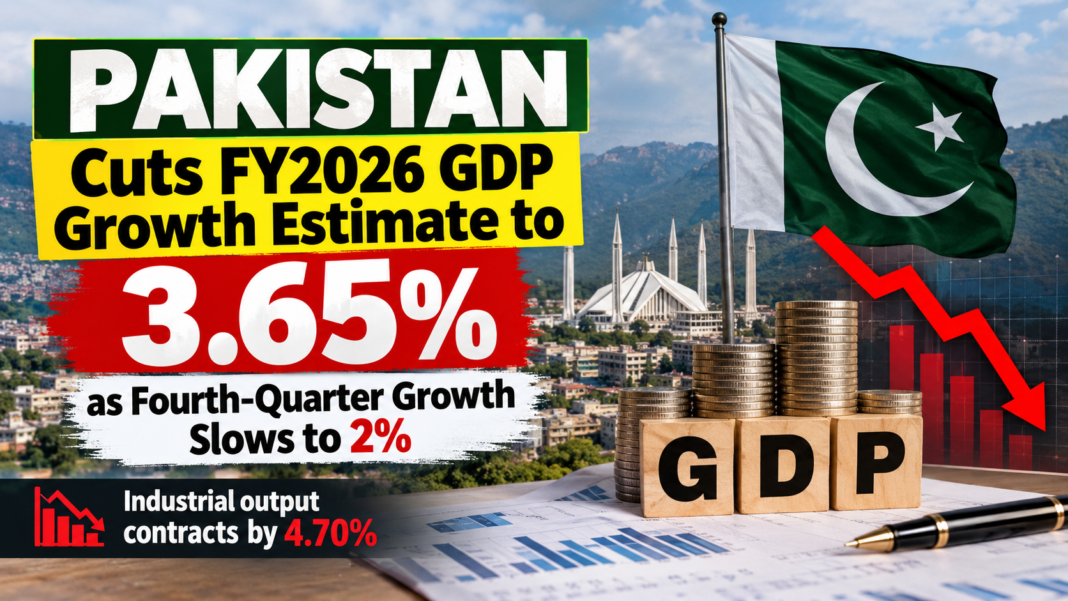
Pakistan’s economy expanded by 3.65% during the 2025–26 fiscal year, below its previous estimate of 3.70%. A sharp industrial contraction in the final quarter highlights the challenges facing the country’s economic recovery.
Pakistan Revises Annual Economic Growth Estimate
Pakistan has revised its economic growth estimate for the 2025–26 fiscal year to 3.65%, down from the previously projected 3.70%, following an assessment of updated national accounts data.
The revised figures were approved on October 19 by the National Accounts Committee (NAC) at a meeting held at the Pakistan Bureau of Statistics (PBS) in Islamabad. The committee also approved updated quarterly growth estimates and revisions to historical import data used in the country’s national accounts.
The adjustment indicates that Pakistan’s economic expansion was slightly weaker than previously estimated. The country had already lowered its growth projection from an earlier target of 4% to 3.70% in May 2026.
The latest revision puts annual growth at 3.65%, highlighting the difficulty of achieving stronger economic expansion amid uneven performance across major sectors.
Fourth-Quarter Growth Drops to 2%
The most significant development in the latest data is the slowdown during the final quarter of FY2025–26, which covered April to June 2026.
Pakistan’s GDP grew by just 2% during this period, compared with 4.42% in the preceding quarter, according to the revised estimates. The slowdown was accompanied by a contraction in industrial activity.
The industrial sector contracted by 4.70% in the fourth quarter, while agriculture expanded by approximately 3.71%. Services recorded growth of 3.62%.
The divergence between these sectors is important because industrial production supports manufacturing, construction, employment and related business activity. A contraction can weaken economic momentum even when other parts of the economy continue to expand.
The slowdown also needs to be viewed in context. Pakistan recorded unusually strong industrial growth in the corresponding quarter of the previous fiscal year, creating a high comparison base. The latest decline therefore reflects both sectoral weakness and the effect of comparing current performance with a particularly strong earlier period.
Pakistan’s Economy Reaches $450.4 Billion
Despite the downward revision in its growth rate, Pakistan’s economy increased in nominal value.
The revised national accounts place the size of the economy at approximately 126.4 trillion Pakistani rupees, equivalent to $450.4 billion, during FY2025–26.
In the previous fiscal year, the economy was valued at approximately 114.9 trillion rupees, or $408.7 billion, according to the updated figures.
Pakistan’s per capita income was estimated at 531,897 Pakistani rupees, equivalent to $1,896, during FY2026, compared with $1,824 in FY2025.
However, an increase in the nominal size of the economy does not automatically mean that households have experienced a corresponding improvement in living standards.
Per capita income is an average measure, not the amount earned by every citizen. Inflation, the cost of essential goods, employment opportunities and the distribution of income all influence how economic performance affects ordinary people.
Consequently, the headline GDP figures need to be considered alongside broader indicators of household purchasing power and economic well-being.
Agriculture Performs Better, but Industry and Services Face Challenges
The revised annual estimates show different growth patterns across Pakistan’s three main economic sectors.
According to the National Accounts Committee, the updated figures for FY2025–26 are:
| Economic indicator | Revised growth or value |
|---|---|
| Overall GDP growth | 3.65% |
| Agriculture growth | 3.50% |
| Industrial growth | 3.34% |
| Services growth | 3.81% |
| Fourth-quarter GDP growth | 2.00% |
| Economy’s nominal value | $450.4 billion |
| Per capita income | $1,896 |
Source: Pakistan Bureau of Statistics and National Accounts Committee.
Agriculture performed better than previously estimated, with annual growth revised upward from 2.89% to 3.50%.
In contrast, industrial growth was revised downward from 3.51% to 3.34%, while services growth declined from the earlier estimate of 4.09% to 3.81%.
These figures suggest that stronger agricultural performance helped support overall economic growth, while weaker industrial and services estimates contributed to the downward revision.
The services sector remains particularly significant because it includes trade, transport, financial activities, communications and other essential economic functions.
The performance of these sectors will be important in determining whether Pakistan can sustain economic expansion and create more employment opportunities in the coming years.
Why the Latest Revision Matters
GDP growth measures the change in the value of goods and services produced by an economy. A lower growth rate does not necessarily mean that the economy is shrinking; it indicates that output is increasing more slowly than previously estimated.
For Pakistan, the revised figure raises questions about the strength and consistency of its recovery.
Businesses rely on stable demand and predictable economic conditions when deciding whether to expand operations, invest in new facilities or recruit additional workers. Slower growth can complicate those decisions, particularly when industrial production is under pressure.
Households may also remain vulnerable if economic growth does not translate into stronger real incomes and improved purchasing power.
Nevertheless, the latest estimates do not establish that every household or business is experiencing worsening conditions. Economic outcomes vary across industries, regions and income groups.
The figures instead point to the importance of examining economic growth alongside inflation, employment, investment and productivity.
Import Data Revisions Add Another Dimension
The National Accounts Committee also approved the incorporation of revised import data covering FY2020–21 through FY2024–25 into the national accounts estimates.
These adjustments form part of the statistical process used to update historical economic measurements and improve the consistency of national accounts. The committee also revised the annual GDP growth estimate for FY2024–25 to 3.11%, down from the earlier figure of 3.18%.
Historical revisions matter because changes in trade data and other economic indicators can affect how previous growth rates are calculated.
For this reason, the latest figures should be understood as revised official estimates rather than treated as a direct comparison with every previously published headline.
Outlook: Can Pakistan Build a Stronger Recovery?
Pakistan’s economy continued to expand during FY2025–26, but the revised annual growth rate and the sharp slowdown in the final quarter underline the challenges ahead.
The immediate priority will be to strengthen economic activity across agriculture, industry and services while encouraging investment and improving the conditions for businesses to operate.
Industrial performance deserves particular attention following the contraction recorded between April and June. At the same time, sustained growth will depend on whether improvements in economic output translate into employment, higher real incomes and more affordable living conditions.
The next set of economic indicators will help establish whether the fourth-quarter slowdown was temporary or a sign of more persistent weakness.
For now, Pakistan’s revised GDP growth estimate of 3.65% presents a mixed picture: the economy is growing, but the pace of expansion remains below the government’s earlier target, and the final quarter showed a substantial loss of momentum.


