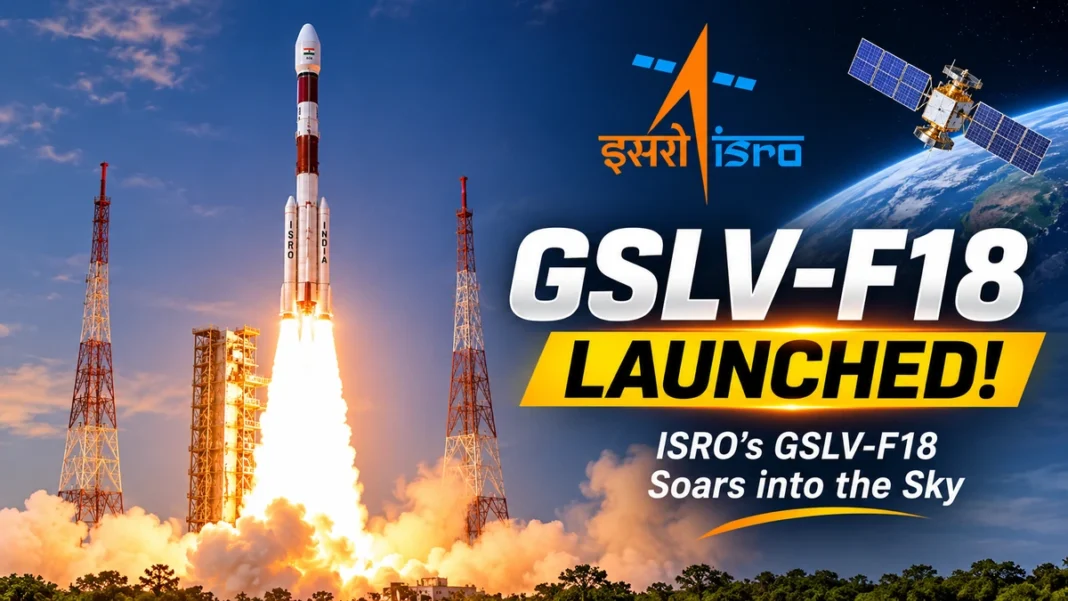
India’s space programme has achieved another significant milestone as the Indian Space Research Organisation (ISRO) successfully launched its GSLV-F18 rocket carrying the next-generation navigation satellite NVS-03 on Friday night, October 30.
The rocket lifted off at 11:51 pm IST from the Second Launch Pad at the Satish Dhawan Space Centre in Sriharikota, Andhra Pradesh. The satellite was successfully separated from the launch vehicle and injected into its intended Geosynchronous Transfer Orbit (GTO), strengthening India’s efforts to maintain and expand its independent satellite navigation infrastructure.
According to ISRO, GSLV-F18 marks the 20th flight of India’s Geosynchronous Satellite Launch Vehicle. The mission is particularly important for the country’s Navigation with Indian Constellation (NavIC) programme, which provides independent positioning, navigation and timing services.
ISRO also shared a video highlighting the mission’s journey, from rocket liftoff to spacecraft separation, through its official social media account on X.
NVS-03: A Major Addition to India’s NavIC System
NVS-03 is the third satellite in ISRO’s second-generation navigation satellite series. It has been developed to ensure continuity and improve the availability of navigation services under India’s Indian Regional Navigation Satellite System (IRNSS), operationally known as NavIC.
The satellite carries an indigenously developed atomic clock alongside procured atomic clocks. Accurate timekeeping is essential for satellite navigation because navigation systems calculate a receiver’s position by measuring the time taken by signals to travel from satellites to devices on Earth.
One of the key technological upgrades in NVS-03 is the introduction of the L1 navigation frequency alongside the existing L5 and S-band signals. The L1 frequency is widely used by civilian navigation receivers, including those found in smartphones and other consumer devices.
This additional frequency is expected to improve NavIC’s compatibility with modern navigation equipment and expand its potential applications.
How NavIC Strengthens India’s Navigation Independence
NavIC, or Navigation with Indian Constellation, is India’s regional satellite navigation system developed to provide positioning, navigation and timing (PNT) services.
The system is designed to provide coverage across India’s landmass and approximately 1,500 kilometres beyond its geographical boundaries.
Unlike GPS, which is operated by the United States, NavIC gives India an independent navigation infrastructure. It has applications across several sectors, including:
Transportation: Supporting road, rail, maritime and aviation navigation.
Disaster management: Helping authorities coordinate emergency responses and rescue operations.
Fisheries: Assisting fishermen with navigation and location-based information.
Defence and security: Strengthening India’s independent positioning and timing capabilities.
Telecommunications: Providing accurate timing references for critical infrastructure.
The addition of NVS-03 is significant because India’s existing navigation satellite constellation has faced challenges involving the availability and performance of some older satellites.
With NVS-03 successfully placed in orbit, India has taken another step towards strengthening the continuity and reliability of its regional navigation services.
ISRO Completes Launch with a 56-Day Turnaround
Another notable aspect of the mission is the time taken between two successive GSLV launches.
ISRO Chairman Dr V. Narayanan highlighted that the GSLV-F18 mission was accomplished with a turnaround time of approximately 56 days between successive GSLV missions, marking an important achievement in the organisation’s launch operations.
Following the successful injection of NVS-03 into its intended transfer orbit, the satellite will undergo further orbital manoeuvres and in-orbit checks before being commissioned for navigation services.
The successful launch therefore marks an important deployment milestone, although the satellite’s placement in orbit does not automatically mean that its navigation services have become operational.
PM Modi Congratulates ISRO Scientists
Prime Minister Narendra Modi congratulated ISRO scientists and engineers following the successful launch.
In a post on X on October 31, he described the mission as an important step towards strengthening India’s indigenous NavIC system. He also highlighted the satellite’s enhanced capabilities and its contribution to India’s pursuit of self-reliance in critical technologies.
The Prime Minister praised the dedication and ingenuity of India’s space scientists, stating that their achievements continued to make the country proud.
The congratulatory message was also published by the Prime Minister’s Office through the Press Information Bureau (PIB).
A Step Forward for India’s Space and Navigation Capabilities
The successful GSLV-F18/NVS-03 mission represents another advancement in India’s efforts to develop independent space-based technologies.
By introducing improved navigation capabilities, an additional civilian signal frequency and indigenous atomic clock technology, NVS-03 is expected to contribute to the long-term development of NavIC.
As India continues expanding its satellite infrastructure, missions such as GSLV-F18 demonstrate the growing importance of indigenous space technology in strengthening national capabilities and supporting civilian applications.