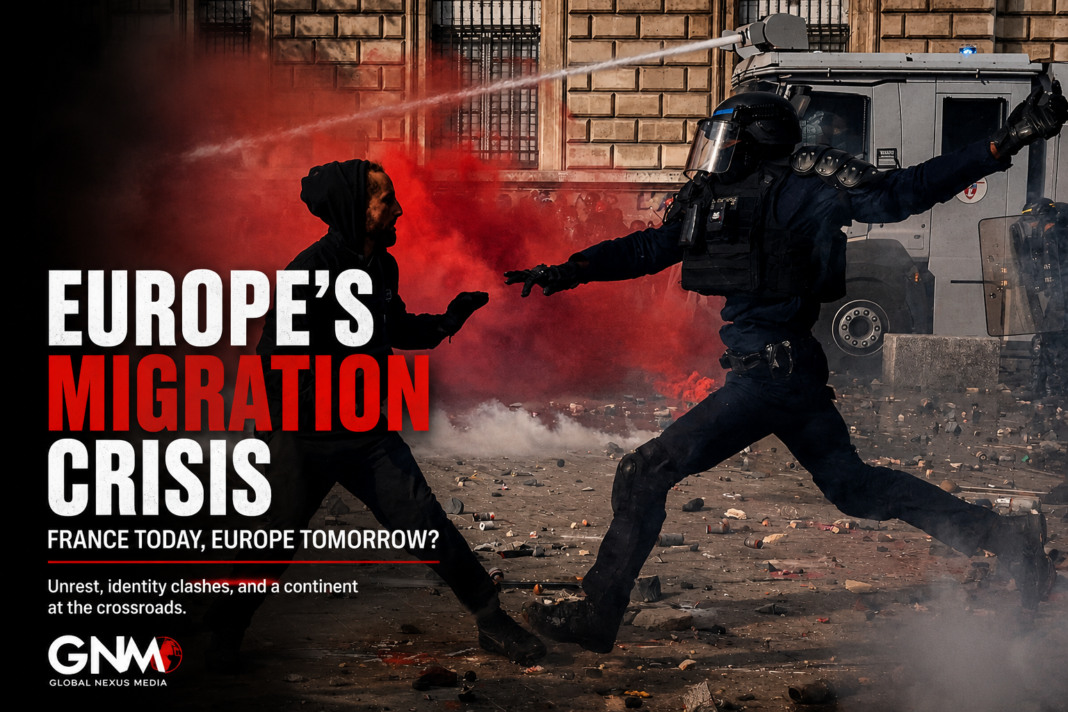
France’s unrest has reopened a difficult debate about migration, religious extremism, cultural integration and public order. The deeper question is whether European governments underestimated the long-term consequences of policies that changed their societies faster than their institutions could adapt.
By GNM Global Nexus Media | World Analysis
The Warning Signs Were There
For years, concerns about migration, demographic change and cultural integration have shaped political debates across Europe. Critics warned that migration policies without effective integration, consistent law enforcement and a shared civic framework could deepen social divisions. These concerns were frequently caught between political polarisation and the difficulty of discussing sensitive issues without generalising about entire communities.
Now, France is once again confronting widespread unrest.
On 17 October 2026, demonstrations across the country brought together students, trade unions and groups associated with the Yellow Vest movement. The stated grievances included rising living costs, deteriorating school conditions, inequality and dissatisfaction with public services. Violence and looting accompanied parts of the protests, causing serious damage to businesses and public buildings.
The Associated Press reported that President Emmanuel Macron condemned the violence on 18 October and said those responsible would be held accountable. It also reported that US President Donald Trump attributed the unrest to immigration, while French authorities had not established a link between immigrants as a group and the rioting.
Read the Associated Press report on France’s protests.
The distinction matters. The immediate causes identified by protesters and French authorities cannot simply be replaced with a different explanation. But neither should the wider questions surrounding migration, integration and social cohesion be dismissed before they are properly investigated.
The question is not whether migration explains every protest. It is whether Europe has adequately confronted the social pressures that can emerge when demographic change, economic insecurity and failures of integration intersect.
Migration Without Integration Is an Incomplete Policy
Migration is not inherently a threat. People move across borders for employment, education, family reunification and protection from conflict. Many build businesses, contribute to public services and become fully integrated members of their adopted societies.
Yet the benefits of migration do not eliminate the responsibility of governments to manage it effectively.
Housing shortages, pressure on public services, barriers to employment, language difficulties and segregated communities can complicate integration. When governments fail to address these challenges, frustration can develop among established residents and newcomers alike.
The political consequences become more serious when citizens believe that their concerns are ignored or that public authorities are unwilling to enforce the same laws for everyone.
European governments must therefore examine whether migration levels, integration capacity and local infrastructure have remained in balance. They must also assess whether newcomers are being given meaningful opportunities to participate in the wider society—and whether civic responsibilities are being communicated and enforced consistently.
Eurostat reported that 4.2 million people immigrated to the European Union from non-EU countries in 2024, alongside 1.5 million people who moved between EU countries. These are migration-flow figures, not the number of irregular migrants or the total foreign-born population.
The scale of these movements makes migration management a substantial policy responsibility. It does not, by itself, establish that immigration caused any particular incident of violence.
The central policy question remains: have governments matched migration decisions with adequate investment in housing, education, employment, language training and integration?
Religious Extremism and the Limits of Tolerance
Europe’s migration debate cannot avoid questions about religion, secularism and competing understandings of public life.
Some Islamist political movements promote interpretations of religious authority that conflict with liberal democratic principles, individual freedom, gender equality or the supremacy of secular law. Extremist organisations have also used religious justifications to promote violence. Such ideologies must be examined openly and challenged wherever evidence demonstrates their influence.

But Islam, Islamist political movements and violent extremism are not interchangeable categories. Muslims across Europe hold diverse beliefs and political views, and many live peacefully within democratic institutions.
The same principle applies to Christianity and other religious traditions. Europe’s own history includes religious persecution, sectarian conflict and struggles over the relationship between religious authority and the state. Modern European secular institutions emerged through a long historical process, not because Europeans have always been naturally tolerant.France Protests Turn Violent:
The relevant standard is therefore not whether a person belongs to a particular religion. It is whether individuals and organisations respect the rights of others, reject violence and accept the authority of the law.
Tolerance cannot mean tolerating intimidation, political violence or attempts to impose religious rules on people who do not accept them. Religious freedom and equal protection under the law must apply to everyone.
European governments should investigate extremist networks, protect people threatened by religious coercion and ensure that crimes are prosecuted without discrimination. They should also avoid treating entire religious communities as responsible for the actions of individuals.
That is how a democratic society can defend both freedom and public order.
When Protest Turns Into Disorder
A protest over school funding or living costs is not the same as a riot. Peaceful demonstrators should not be held responsible for the actions of people who exploit a crowd to commit crimes.
At the same time, the destruction of businesses, attacks on public buildings, arson and looting cannot be excused simply because they occur during a demonstration with legitimate grievances.150 Detained, Including CJP Leader Abhijeet Dipke and AISA President Neha Bora, During Protest Against CEC Gyanesh Kumar
The distinction is particularly important in France. Reuters reported that the school protests began with complaints about overcrowded classrooms, teacher shortages and deteriorating facilities, before expanding into a wider movement involving economic and political grievances.
Read Reuters’ reporting on the French school protests.
The unrest must be investigated on its own evidence. Who committed the offences? Were the perpetrators connected to the original demonstrations? What do arrest records, prosecutions and verified footage reveal? Were there organised groups involved, and what were their motives?
These questions matter more than assumptions based on appearance, religion or perceived ethnic background.
If verified evidence establishes that particular individuals or organisations exploited the unrest, their actions should be reported directly. If a connection to migration or extremist ideology is alleged, that connection must be substantiated rather than inferred from a video alone.
A state that cannot protect businesses, public institutions and peaceful citizens risks losing public confidence. But effective law enforcement also requires proportionality, accountability and respect for the right to peaceful protest.
France Is Not the Whole of Europe
France, Germany, Britain and Italy have different migration histories, asylum systems, labour markets and integration policies. Their political tensions cannot be reduced to one common explanation.
Nevertheless, each country faces questions about how to balance border management, humanitarian commitments, economic needs, social integration and public expectations.
The Organisation for Economic Co-operation and Development has documented a growing policy focus on civic integration, labour-market participation, housing and social belonging across its member countries.
Read the OECD’s International Migration Outlook 2024: Integration Policy.
These are not peripheral concerns. They affect whether newcomers can participate in society, whether communities develop trust and whether public institutions retain legitimacy.
Governments that dismiss every concern about migration risk alienating citizens who want honest answers. Political actors who blame every social problem on immigrants risk encouraging hostility without solving the underlying problems.
A serious approach requires evidence, effective administration and the willingness to correct policies that fail.
What India Can Learn From Europe
India offers a different perspective on the challenges of religious and cultural diversity. Its constitutional framework and long history of multiple religions, languages and traditions create a distinct context from that of European countries.
India also faces communal tensions and cannot claim immunity from intolerance. Its experience should therefore be treated as a point of comparison, not as proof that one society has solved every problem while another has failed.
The broader lesson is that diversity alone does not guarantee social harmony. Peace requires institutions that enforce the law fairly, protect individual rights, prevent intimidation and maintain a shared civic framework.
For India, the European debate reinforces the importance of social cohesion, effective policing, responsible public discourse and institutions that retain the confidence of citizens from different backgrounds.
For Europe, the challenge is to recognise that welcoming migrants and maintaining national cohesion are not mutually exclusive objectives. Both require clear rules, realistic planning, equal treatment under the law and sustained investment in integration.
The Real Warning: Do Not Confuse Silence With Stability
The unrest in France deserves investigation beyond the immediate headlines. But it should not be treated as automatic proof of a predetermined theory about immigration, religion or demographic change.
The warning signs raised in earlier debates about European migration policy deserve to be tested against present-day evidence. Migration flows, integration outcomes, crime statistics, public opinion and the circumstances of individual incidents can help establish which concerns are supported and which remain unproven.
The objective should be neither to defend every past policy nor to condemn entire communities. It should be to understand where governments have succeeded, where they have failed and what must change.
Europe’s challenge is not simply migration. It is whether democratic governments can manage migration, uphold the law, confront extremism, protect individual freedoms and maintain social cohesion at the same time.
A government cannot build lasting public confidence by ignoring legitimate concerns. Nor can a society solve its problems by blaming an entire community. The way forward is honest debate, effective integration, equal justice and the courage to confront failures wherever the evidence leads.